Cultural Education & Societal Discourse in Münster
Cultural Education & Societal Discourse in Münster: What Will Be Important in the Coming Years
How does a theater project at a primary school in Münster change a child's self-confidence – and what could a gaming workshop in a youth center mean for democratic participation in the future? Anyone who closely follows cultural education in Münster in the coming years will quickly notice: Behind choir rehearsals, circus projects, poetry slams, and film clubs, there is much more than just leisure activities.
For the future, two developments are particularly clear: First, the question of fair participation in cultural offerings in all districts will continue to gain importance – especially where financial, linguistic, or time barriers are high. Second, the societal discourse around belonging, migration, diversity, and criticism of racism is likely to intensify and at the same time become more differentiated. Both will shape how cultural education in Münster will be planned, financed, and implemented in the future.
This article shows what role cultural education in Münster can play in the future for personal development, social cohesion, and societal discourse, what opportunities it opens up – and which next steps are particularly effective.
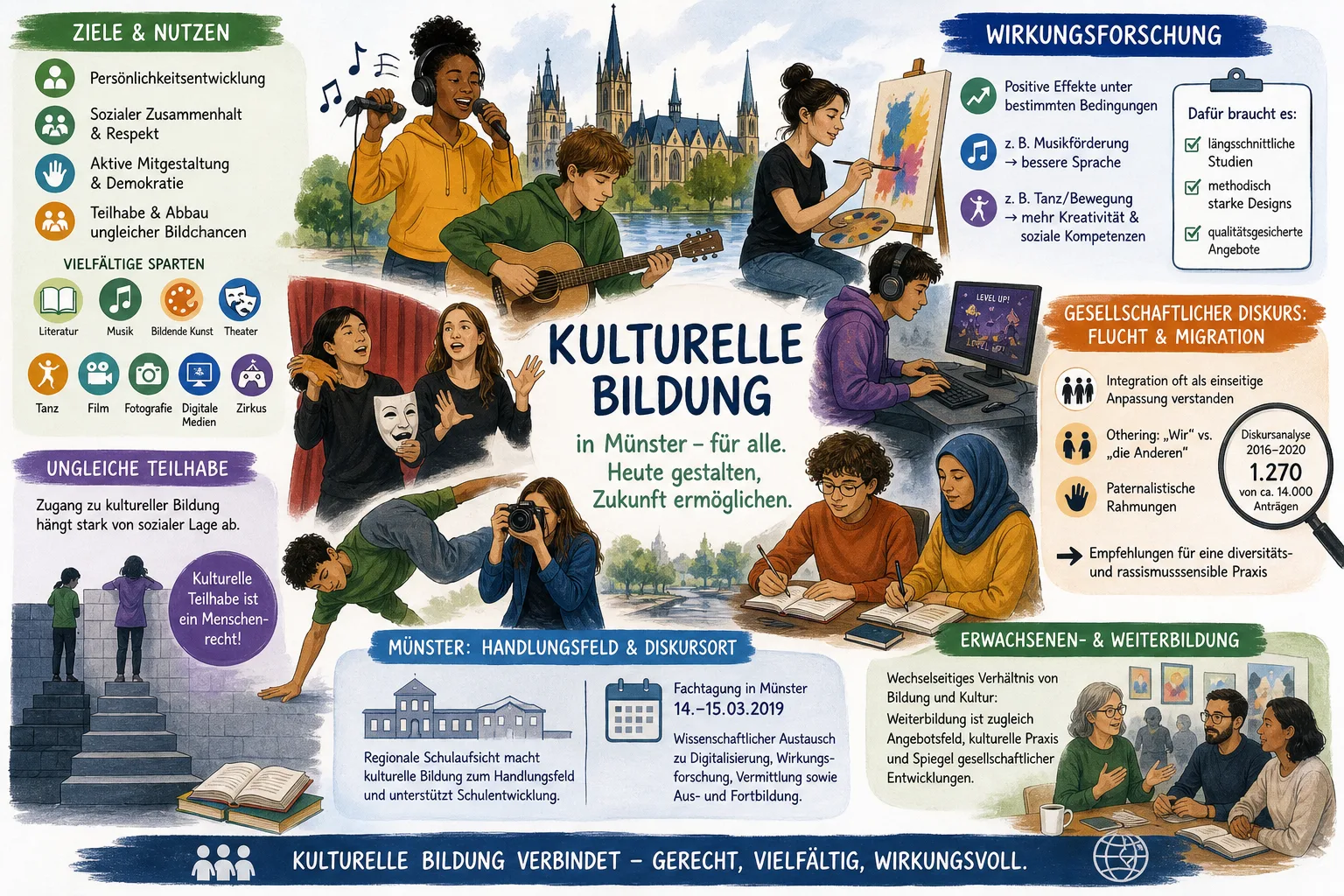
Goals of Cultural Education: More Than Just a Nice Extra
Cultural education in Münster will continue to gain weight in the coming years as an independent field of action in the education sector: Schools, youth facilities, and adult education providers can expand it as a cross-sectional task to enable children, young people, and adults to actively engage with personal and societal questions.
It's not just about classic fields like literature, music, or visual arts, but also about theater, dance, film, photography, digital media, play and gaming, and circus. This very diversity opens up different approaches – from comic drawing to movement theater, from rap workshops to photo projects in the neighborhood.
Core Goals That Will Especially Matter in the Future
- Personal development: Those who compose a piece of music, try out their own game design, or help plan a circus project experience self-efficacy. Good projects promote the ability to express oneself, creativity, and the courage to show one's own voice.
- Social cohesion: Choirs, theater ensembles, or dance groups only work together. Roles are distributed, conflicts negotiated, responsibility assumed – cultural education thus becomes a training ground for respect and cooperation.
- Active participation: Projects in public spaces (e.g., exhibitions in neighborhood centers or artistic interventions in squares) can make it more visible that residents help shape their district. Culture becomes a driver of democratic participation.
- Reducing unequal opportunities: If offerings are consistently carried into daycares, schools, and neighborhoods with increased support needs, cultural education can reduce educational disadvantages – especially if it is free of charge, low-barrier, and reliably accessible.
This means that cultural education in Münster will in the future be even more closely linked to democracy education, recognition, and the question of fair participation. It creates spaces in which different life worlds become visible – and in which respectful debate, negotiation, and learning can take place about them.
What Will Be Effective in the Future? Aligning Research and Practice Together
In the coming years, it will be crucial in Münster to strengthen cultural education not only through good intentions but through clear quality characteristics and verifiable goals. Research on cultural education does not show a "one-size-fits-all" logic, but it does make visible the conditions under which projects become particularly sustainable.
Quality Factors That Münster Can Specifically Expand
- Artistic quality and pedagogical professionalism: Projects unfold their strength when artistic signature and good mediation come together.
- Reliable durations: Long-term formats enable relationship work, trust, and real development steps instead of short "event" effects.
- Genuine participation: When participants help decide on topics, roles, and presentation forms, identification increases – and the results become more relevant to their life world.
- Good transitions: Connections to music schools, clubs, youth centers, or school clubs ensure that motivation does not fizzle out after the project ends.
- Reflection and evaluation to the right extent: Short feedback loops, documented learning objectives, and transparent criteria help ensure quality without stifling artistic freedom.
A sensible next step for Münster will be to systematically interlink research and practice: through regular professional dialogues, joint training, and a comprehensible preparation of findings for educators, cultural actors, and administration.
Unequal Participation: Which Barriers Münster Must Dismantle in the Future
Even though cultural life in Münster is diverse, the central question for the future will remain: Who can actually use the offerings – and who is left out? Access to cultural education in many contexts is closely linked to time budgets, financial resources, mobility, language access, and knowledge about available opportunities.
Barriers That Will Be Particularly Practically Relevant in the Coming Years
- Costs & follow-up costs: Participation fees, materials, travel, or suitable equipment can be discouraging.
- Time & everyday life: Shift work, care work, or lack of childcare can make regular participation difficult.
- Accessibility: Distances, opening hours, and a lack of connection to everyday life in the neighborhood act as barriers.
- Information & language: If offerings are only communicated through certain channels or only in one language, they do not reach many target groups.
- Invisible thresholds: Those who do not feel "meant" in cultural spaces participate less often – even when doors are formally open.
Internationally, cultural participation is understood as part of fundamental rights. For Münster, this results in a clear mandate for the future: to design offerings so that participation does not depend on parental home, wallet, or familiarity with cultural institutions.
Strategies That Münster Can Consistently Implement in the Future
- Cooperation with schools and all-day programs: When cultural education is anchored in everyday school life, it also reaches children whose families do not actively seek out offerings.
- Neighborhood orientation: Culture can go where people are: in neighborhood centers, schoolyards, youth clubs, and public spaces.
- Low-threshold access: Clear registration, simple language, low-barrier locations, and reliable contacts lower inhibitions.
- Participation design instead of "target group design": Formats, times, locations, and presentation forms are developed from the perspective of the participants – not just from the logic of the institution.
Migration, Diversity, and Critique of Racism: How Münster Can Lead the Discourse Better in the Future
In the coming years, debates about belonging, migration, multilingualism, and diversity will continue to shape everyday social life. Cultural education can play a special role here: It can create spaces where people express experiences, make conflicts visible, and try out new perspectives – without everything having to be immediately resolved into "right/wrong."
Discourse Risks That Projects Should Avoid in the Future
- One-sided logic of adaptation: If "integration" is only thought of as adaptation to an allegedly homogeneous "us," hierarchies arise instead of encounters.
- Othering: If people are generally described as "the others," individual biographies and competencies become invisible.
- Paternalism: If participants are primarily seen as "in need of help," their resources and self-determination are pushed into the background.
Principles for a Diversity- and Racism-Sensitive Practice in Münster
- Co-creation instead of representation: Projects work with people – not about them. Topics, languages, and aesthetic forms are decided together.
- Shared decision-making power: Participation is particularly effective when communities are involved in planning, implementation, and evaluation (e.g., in the team, in curator roles, or on advisory boards).
- Language sensitivity: Terms like "our values" or blanket attributions are scrutinized: Who is described how, and whose perspective is missing?
- Team reflection: Training on anti-discrimination pedagogy, protection concepts, and feedback culture help reduce blind spots.
If Münster anchors these principles more broadly in the coming years, cultural education can not only reflect diversity but also promote fairer structures – and thus make local discourse more resilient, respectful, and democratic.
Cultural Education for All Life Phases: What Münster Can Expand Up to Adult Education
Cultural education in Münster will in the future take place not only in classrooms and youth centers. Adult education and continuing education can also be important places where education and culture come together – and where societal questions are addressed through artistic means.
Why Continuing Education Is Strategically Important for the Coming Years
- New access in adulthood: Adults who had little contact with culture during their school years can find later entry points – not as a deficit, but as a legitimate learning biography.
- Take digital cultural forms seriously: Media art, video, podcasting, or gaming can be not just "tools," but independent cultural forms that enable creative and political forms of expression.
- Address societal issues: Democracy, sustainability, gender equality, racism, and social inequality can be negotiated in artistic formats – dialogically and based on experience.
In parallel, the qualification of teachers, cultural educators, and artists will remain key: Training on digital mediation, child protection/protection concepts, low-barrier design, and evaluation can help ensure that offerings are professionally strong and trustworthy.
Outlook: Concrete Next Steps for Münster's Cultural Education
Cultural education and societal discourse will continue to be closely intertwined in Münster in the future. So that projects not only "take place" but also have a lasting impact, the following steps are realistic and meaningful in the coming years:
- Consciously shape digitalization: Participation requires device access, media competence, data protection, and quality standards – so that digital formats do not create new exclusions.
- Organize participation more fairly: Funding logics, spaces, and times should be designed so that they actually reach people in challenging life situations.
- Stabilize cooperation: When culture, social work, schools, and neighborhood development work together reliably, sustainable learning and protection spaces are created.
- Anchor diversity competence: Not as an add-on, but as a standard: in language, personnel development, program selection, and participation structures.
This way, cultural education in Münster can contribute in the coming years to ensuring that people not only live in this city, but actively help shape it – in words, sounds, images, movements, and digital worlds.