Zero Waste & Green Events in Münster: Celebrate Sustainably
Zero Waste & Green Events: How Future Events in Münster Will Be Planned with Environmental Awareness
A practical guide for upcoming festivals, cultural evenings, conferences, and neighborhood events in Münster: reusable options, tap water, climate-friendly travel, sustainable catering, and transparent communication – without unnecessary mountains of waste.
Vision: Celebrating Without Piles of Waste – What Is Possible at Future Events
Imagine your next event in Münster: great atmosphere, good conversations, music or a program – and at the end, one thing is left behind on the grounds: order. Cups are returned and washed, water is provided at refill points, and waste is only generated where it truly cannot be avoided.
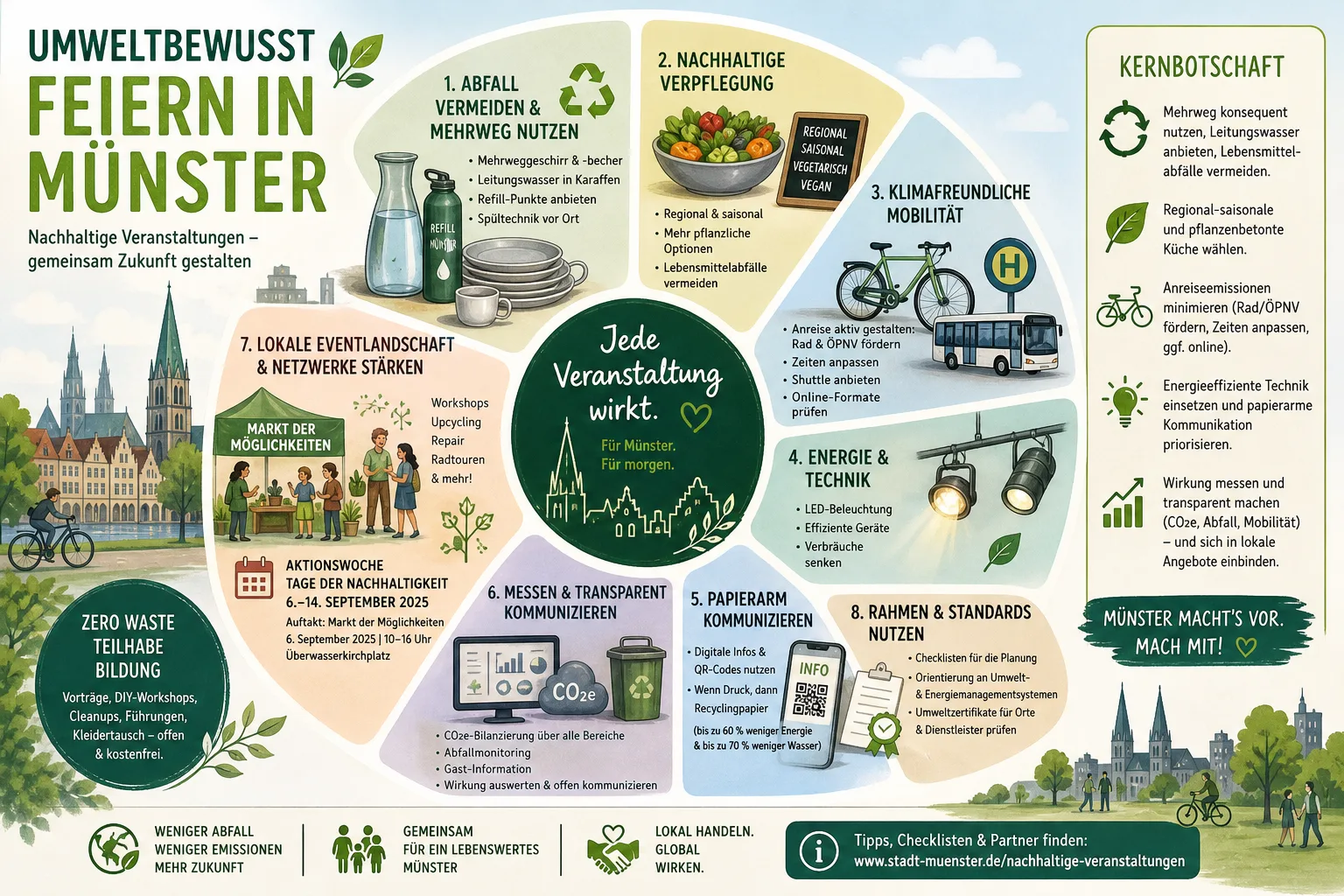
This vision can be systematically planned for future events – with clear standards (reusables, tap water), a good mobility strategy (prioritizing bikes and public transport), and procurement that considers waste prevention before the first purchase. This way, sustainability is not an add-on at the end, but the common thread running through the upcoming event.
Zero-Waste Principles for Upcoming Events
1) Prevent Waste Before It Occurs
For the next event, a quick reality check during the planning phase is worthwhile: Which materials, packaging, and disposable items would automatically arise – and which of these can be replaced by other decisions? The basis for this is waste prevention and reuse, as also prioritized in the European waste hierarchy.
2) Reusables as the Standard (Not the Exception)
- Plan reusable dishes and cutlery for food and beverages (including deposit system and return points).
- Set up a washing concept in advance: venue kitchen, mobile washing trailer, or service provider with pick-up/drop-off logistics.
- Reduce single-use portions: provide sugar, milk, sauces, stirrers, and napkins only where they are truly needed.
3) Offer Tap Water Visibly
For upcoming events, tap water can be planned as a standard service – for example, via carafes, drinking water stations, or clearly marked refill points. This reduces packaging and transport effort and is also a low-threshold service for guests.
- Place refill stations so that queues are avoided (e.g., several points instead of one central spot).
- Welcome guests' own bottles (note in ticket/email/website).
- Explain on site where water is available and why this is part of the green event concept.
4) Think Circularly About Materials and Decorations
For the next party or conference: decorations, banners, stage backdrops, and signposts should be planned to be reusable, borrowable, or made from durable materials. This breaks the "buy once – dispose once" pattern before it even starts.
Food & Drink: Regional, Seasonal, Plant-Based – and Plannable
Regional & Seasonal: The Call for Tenders Decides
When requesting catering for your next event, you can make sustainability concrete by including criteria in your request: seasonal menu planning, regional sourcing, and transparent ingredient lists. This makes the selection comparable and not just a matter of marketing.
- At least one seasonally influenced menu (e.g., with clearly named seasonal products).
- Regional sourcing shares as a criterion (as long as the caterer can document this reliably).
- Reusable logic also for catering (containers, transport boxes, serving).
Plant-Based as Default
For upcoming events, the food offering can be structured so that vegetarian and vegan options are not "special cases" but form the basic selection. This makes planning easier, reduces complexity at serving points, and fits common recommendations for more climate-friendly diets, without prescribing anything to guests.
Avoid Food Waste: Planning Instead of "Better Safe Than Sorry"
- Realistic quantity planning based on registration numbers, experience, and time slots (snack vs. full meal).
- Refill logic instead of overloaded buffets (smaller containers, refill more often).
- Set clear paths for leftovers (e.g., controlled redistribution in accordance with hygiene regulations).
Arrival & Energy: The Biggest Lever in the Event Balance
Plan Mobility from the Start
For the next event, a change of perspective is worthwhile: a large part of the climate impact often arises from arrival and departure. That’s why mobility in Münster belongs not at the "end info," but in the core planning.
- Prioritize public transport and bike arrival: clear information in invitations, ticket emails, website, and on site.
- Provide sufficient, well-lit, and conveniently located bike parking near the entrance.
- Actively manage parking: if parking spaces are to be limited, communicate early and offer alternatives.
- Check hybrid/online components if many guests would otherwise have to travel long distances.
On-Site Energy: Efficient, Needs-Based, Documentable
- LED lighting and needs-based illumination (zones, schedules, dimming).
- Size technology appropriately (don’t overplan sound/light if the space doesn’t require it).
- Control heating/cooling via operating times and target temperatures (don’t climate-control rooms "just in case").
Make Impact Visible: Monitoring for Next Time
If you want to become more robust for future editions, simple monitoring helps: amounts of residual waste/packaging, number of reusable cycles, estimated mobility shares (e.g., short guest survey), and energy data from the location. A short results section in the post-event report builds trust because it makes clear what was planned, implemented, and learned.
Digital, Paper-Light, Transparent: Communication That Pulls Along
Organize Paper-Light
- Digital tickets and check-in lists instead of printouts.
- Program available digitally (website or PDF) and accessible on site via QR code.
- Plan signage to be reusable (modular systems, boards, robust print carriers).
Transparency Without Greenwashing
For upcoming green events: only promise what you can actually deliver – and explain measures briefly and comprehensibly. Examples of clear, verifiable statements are "reusable cups with deposit system" or "drinking water stations at three points." Avoid blanket promises like "climate neutral" if there is no reliable methodology and transparent documentation behind it.
Guests as Part of the Solution
Good communication makes it easy for guests to participate: Where do I return cups? Where do I refill water? How do I best get there? What happens to leftover materials? Those who answer these questions clearly for the next event reduce friction – and thus also waste and frustration.
Participatory Formats in Münster: Marketplace of Opportunities & Workshops (Future Editions)
In the coming months and years, formats in Münster are still conceivable that combine sustainable action with events: action weeks, participatory markets, repair and upcycling offerings, as well as educational formats for neighborhoods, clubs, and organizations. If you are planning an event yourself, such modules can be integrated as program points – for example, as a short impulse, as an exchange format, or as an accompanying participatory station.
This Is How You Integrate a "Marketplace of Opportunities" into Your Next Event
- Small area, big effect: 5–10 local actors with a clear thematic focus (e.g., reusables, repair, upcycling, mobility).
- Participation instead of brochures: short demos, mini-workshops, repair checks, or swap corners.
- Practical takeaways: checklists, QR codes to contact points, registration options for follow-up dates.
Workshops, Repair Formats, and Cleanups as Program Modules
For future events, the following work especially well: short DIY units (e.g., upcycling), moderated repair consultations (e.g., textiles or electronics in cooperation with experienced volunteers), and cleanup actions as a kick-off or conclusion. What matters is that the process, safety, and disposal routes are established in advance.
Checklist: How to Plan Your Next Green Event in Münster
-
Define goals for the upcoming event
- Which three measures have priority (e.g., reusables, tap water, mobility)?
- How will they be secured organizationally (budget, responsibilities, schedule)?
-
Set up reusable & return system
- Deposit amount, distribution and return points, washing and transport logic.
- Briefing for all stands/teams so the system works uniformly.
-
Plan drinking water/refill as a service
- Dimension number of stations according to expected guests and weather.
- Clear signage and information in advance communication.
-
Sustainably tender catering
- Seasonal planning, plant-based base, reusable serving, waste prevention.
- Quantity planning and refill system to reduce food waste.
-
Treat mobility as a core topic
- Prominently place bike/public transport info (not in the fine print).
- Organize bike parking and routing on site.
-
Design energy and technology efficiently
- Size technology according to needs, set operating times.
- Only heat/cool rooms when they are actually in use.
-
Explain clearly on site
- Short, clear instructions: "This is how reusables work," "Here is water," "This is how you separate waste correctly."
- Team check-in before admission: Who answers which questions?
-
Follow-up for the next edition
- What prevented waste, what took time, what was well received?
- Document findings and incorporate them into planning the next event.
This way, step by step, an event is created that becomes easier to plan for future editions: less chaos at the end, less disposal, more quality in the experience.
Sources
- City of Münster (Website) — Information and publications on sustainability and event organization (accessed 2026-06-24)
- Federal Environment Agency (UBA) — Technical information on waste prevention, circular economy, and environmental impacts (accessed 2026-06-24)
- European Commission: Waste Framework Directive — Waste hierarchy and basic principles of EU waste policy (accessed 2026-06-24)
- BMUV (Federal Ministry for the Environment, Nature Conservation, Nuclear Safety and Consumer Protection) — Framework information on waste prevention and climate protection measures (accessed 2026-06-24)