
Energy Infrastructure for More Capacity
Plant in Münster Plans Fourfold Increase in Connection Capacity: BASF Coatings Expands Energy Infrastructure
BASF Coatings is expanding its energy infrastructure at the Münster site. According to the company, plant manager Wolfram Schier and the project team for power supply and construction technology kicked off the construction work last week with a symbolic groundbreaking ceremony. The project aims to increase supply security, expand the share of renewable energies at the site, and at the same time create capacities for future expansions. The project will be implemented in several construction phases together with the City of Münster, Stadtwerke Münster, and Stadtnetze Münster.
The Core of the Expansion is a New Transfer Station
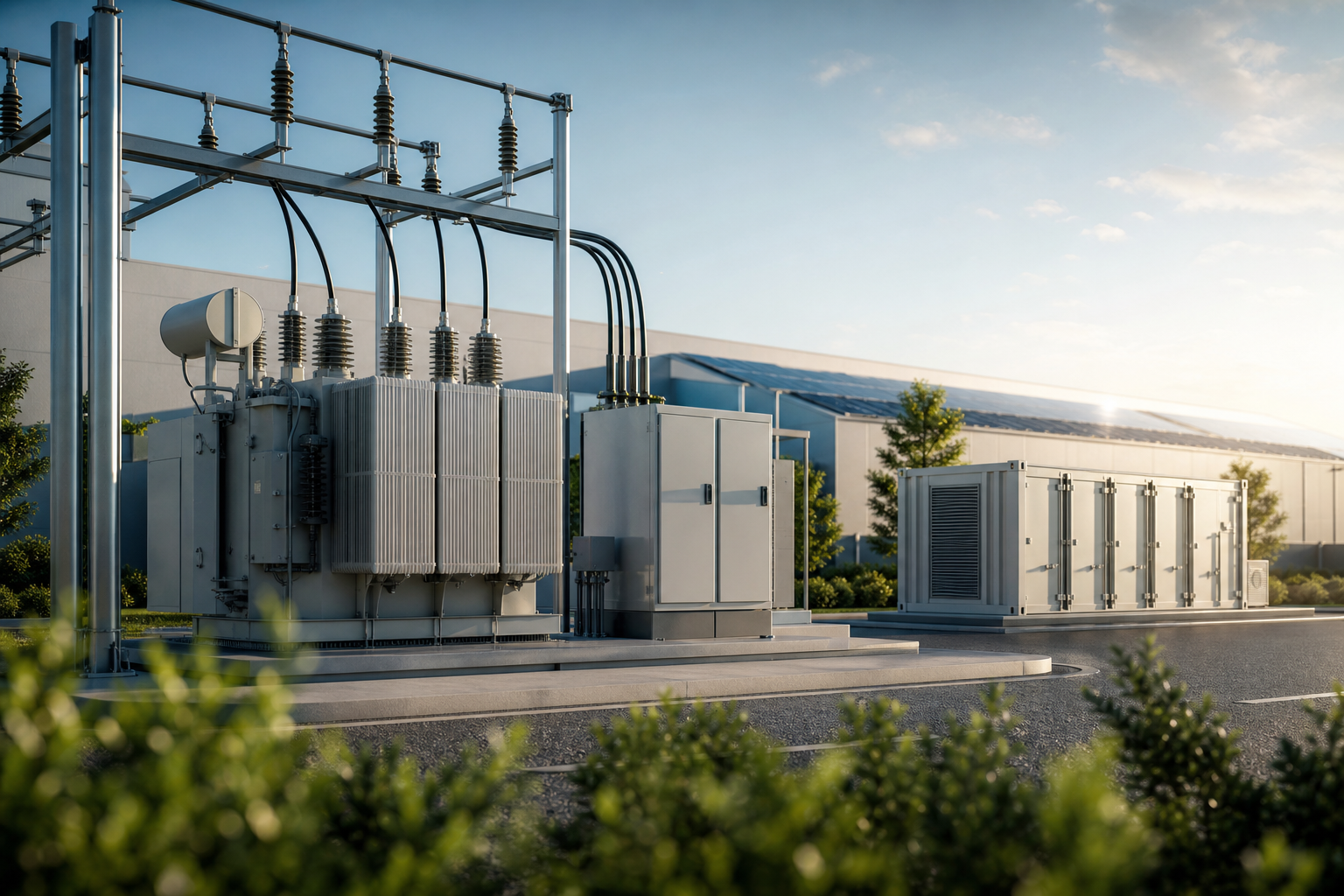
The focus of the first phase is the replacement of the previous feed-in station with a larger transfer station. At this interface, the plant receives electrical energy from the public grid operator and then distributes it via its own plant infrastructure. Technically, this is primarily a measure to increase capacity and robustness: the larger and more powerful the transfer technology, the better the operation can be secured against bottlenecks – and the more leeway there is when facilities are expanded or additional consumers are connected.
BASF Coatings explicitly links this point to growth prospects. Project manager Norbert Meyer is quoted in a company statement as saying that with the commissioning of the new station, "the available capacity can be increased fourfold if necessary"; this will not only cover current demand, but also lay the foundation for possible expansions. Specifically, BASF Coatings puts the increased electricity connection capacity for Münster at 40 megawatts. This turns the abstract "fourfold" statement into a measurable target for the plant's energy connection.
Photovoltaics and Battery Storage to Cushion Peak Loads
In parallel with the grid connection, BASF Coatings is planning photovoltaic systems – including on the roof of the new station as well as on other buildings. In addition, battery storage systems are to be installed to absorb excess energy and make it available again when needed. For an industrial site, this combination is especially relevant when generation and consumption do not coincide in time: solar power is generated during the day, but demand may shift to other times. Storage can smooth out such fluctuations, reduce peak loads, and thus both increase the use of self-generated electricity and reduce dependence on short-term grid power.
The fact that storage technology is gaining importance in Münster beyond individual company projects is demonstrated by a regional project of Stadtwerke Münster: together with VERBUND Energy4Business Germany, a large battery storage system with 16 megawatts of power has been announced in the Hansa Business Park. The explicit goal there is more grid flexibility and better integration of renewable energies – a signal that the region is also working on the stability and controllability of the power system in parallel.
Site Strategy: Expansion, Supply Security, and Emission Reduction
BASF Coatings places the infrastructure expansion in Münster in a dual context. Plant manager Wolfram Schier emphasizes, on the one hand, the economic perspective: the measures strengthen performance and create the prerequisites for further growth at the site. On the other hand, he links the project to climate goals and describes it as an important step towards reducing emissions.
What will be decisive is how much the additional capacities are actually backed by renewable sources and more efficient use: photovoltaics and storage increase flexibility within the plant, while a stronger grid connection primarily secures supply and enables expansions. Further steps – such as increased use of "green heat" and additional expansion of public infrastructure – are still in the planning stage, according to the company.
The project is also noteworthy for Münster because industrial requirements, municipal energy players, and infrastructure planning come together here. The conversion at the BASF site shows how supply security and transformation often have to be organized simultaneously in practice: through more grid capacity, through own generation, and through storage – and in stages, the impact of which can only be fully assessed as the construction phases progress.
Frequently Asked Questions
Sources
- https://www.wirtschaft-aktuell.de/news/photovoltaik-und-batterien-basf-coatings-startet-projekt-in-muenster, 26.05.262026
- https://www.basf-coatings.com/global/de/media/Press-Releases/2025/Erh-h-hung-der-Stromanschlusskapazität-am-Standort-M-nster
- https://www.stadtwerke-muenster.de/unternehmen/presse/Pressemitteilungen/2024/kooperation-f%C3%BCr-mehr-flexibilit%C3%A4t-im-stromnetz