
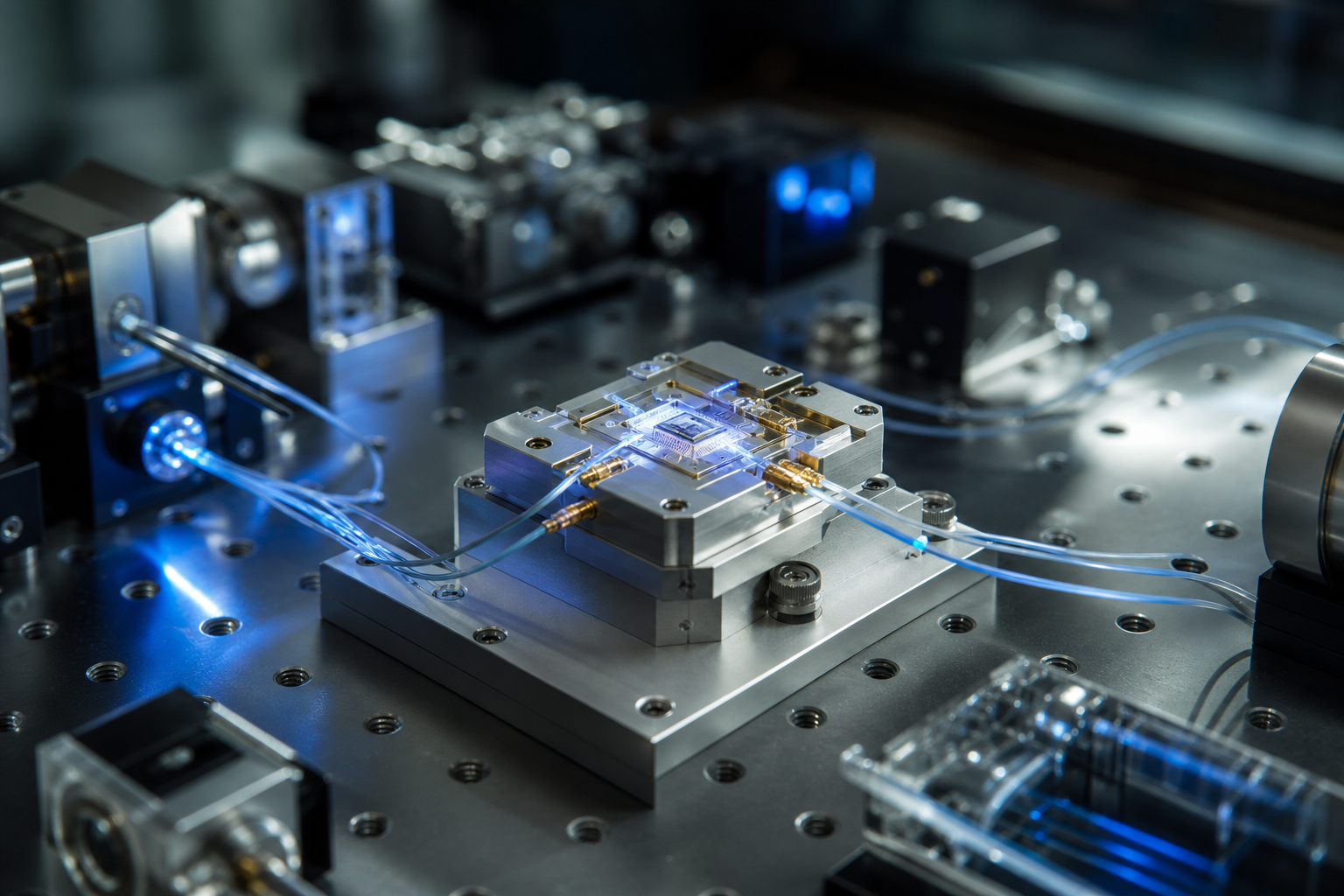
Symbolbild mithilfe von KI erstellt
Quantum technology from Münster in focus
This start-up makes individual light particles visible – and could push quantum hardware into the market
The Münster-based quantum technology start-up Pixel Photonics is in the finals of the German Founders Award 2026. This puts a company in the spotlight that is working on a key component for future quantum and sensor systems: detectors that reliably register individual photons – and can also be integrated in such a way that they become industrial-grade hardware.
The award ceremony is scheduled for September 8, 2026, at the ZDF Capital Studio in Berlin. The finalist programs of the German Founders Award are aimed at young companies that are supposed to demonstrate growth and market maturity within a few years – precisely the hurdle at which many deeptech companies fail: it is not the idea that is scarce, but the translation into a robust, scalable product.
Why being a finalist is economically more than just a start-up podium place
Quantum technology has been considered a strategic field for years – but in practice, progress often depends on inconspicuous building blocks. Single-photon detectors are among them. They are needed wherever extremely weak light signals must be translated into usable data:
- Quantum communication
- Certain approaches in quantum computing
- Precision measurement technology
- Imaging and sensor technology
This is relevant for companies and investors because an entire value chain depends on such components: those who master detection, readout, and integration do not just deliver a laboratory device, but can become suppliers for system providers – with recurring revenues, high technical entry barriers, and potentially long product cycles.
From research achievement to chip and system integration
Pixel Photonics was founded in 2020 as a spin-off from the University of Münster. The company is working on combining single-photon detection with photonic integrated circuits – that is, bringing light guidance and functionality onto or into compact chips. The crucial point is not that individual photons become "visible," but that detection is reproducible, packable, and integrable into systems.
In research, setups can be large, sensitive, and maintenance-intensive. For industrial applications, however, other criteria count:
- Stable performance over long periods
- Standardized interfaces
- Manufacturing yield
- Serviceability
- Cost per channel
Especially with single-photon detectors, many high-performance approaches require complex peripherals. The path from peak value in the lab to a reliable series component is therefore often longer than the public debate about "quantum leaps" suggests.
Tailwind from SPRIND – and what that can mean in practice
Additional momentum comes from a grant of 1 million euros from the SPRIND environment, aimed at further developing waveguide-integrated detectors and their multi-mode capability. Behind this type of funding is a very concrete industrial policy idea: not just better measurement values, but a technology that can be integrated into existing device classes – for example, in microscopy, diagnostics, or laser communication.
For Pixel Photonics, this is also strategic: those who show early that integration and scaling succeed increase the likelihood that pilot customers from industry and research will not stop at prototypes, but will move on to procurement, qualification, and subsequent generations. In deeptech, this is often the moment when a "promising technology" becomes a viable business model.
Competition in the finals: Deeptech as a common denominator
In the context of the finals, several technology-driven companies are competing, including DeepDrive from Garching (electric motor technology) and mtex antenna technology from Wiesbaden (antenna systems). This underlines the standard that the German Founders Award sets for young companies: growth is not understood solely as rapid scaling in the platform or software sense, but as proof that sophisticated technology can make the leap into an industrial market.
Signal effect for the Münster location – and the open question until September
For Pixel Photonics, being a finalist means two things: recognition within the German start-up scene and at the same time a stress test for its own story in the market. Because in quantum technology, in the end, it is less about the buzzword and more about the ability to deliver: can detectors be provided in quantities, with stable parameters, and in form factors manageable for system builders?
Whether Pixel Photonics will also win the prize on September 8 will be decided in Berlin. Regardless, the finalist position already shows that a highly specialized hardware topic – single-photon detection and integration – is perceived as an economically relevant bet. In a field where many promises fail at scaling, that is the real news.
Frequently Asked Questions
Sources
- https://www.wirtschaft-aktuell.de/news/muenster-pixel-photonics-im-finale-des-deutschen-gruenderpreises-2026, 10.06.2026
- https://www.pixelphotonics.com/download-file?file_code=f72f7dcf9c&file_id=410
- https://www.bundeswirtschaftsministerium.de/Redaktion/DE/Wettbewerb/deutsche-gruenderpreis.html
- https://www.optica.org/about/newsroom/corporate_member_news/2025/pixel_photonics_receives_eu1_million_sprind_funding_for_multi-mode_single_photon_detection/
- https://www.deutscher-gruenderpreis.de/teilnahme/bewerbung/