
Cross-border cooperation in focus
MONT cities rely on new impulses for Europe's future
In the cross-border city network MONT, Münster has handed over the chairmanship to Hengelo. The meeting in Münster was not only about the formal handover, but also about concrete projects – from the application for the title "European Youth Capital 2029" to questions of urban development at the harbor.
The MONT association includes Münster, Osnabrück and the Twente region with Enschede, Hengelo and Almelo. The cooperation aims to position the German-Dutch border region as an innovation and knowledge area in Europe and to advance collaboration, for example in climate protection and future-proof mobility.
The chairmanship changes, the agenda remains pragmatic
The change at the top is above all a signal of continuity: MONT relies on reliable coordination across the border – and on projects by which its ambitions must be measured. Fuchs was quoted as spokesperson: "In the MONT city network, each city brings its own strengths, perspectives and challenges. From this trusting exchange, joint answers to the major questions of the future arise – across borders and through mutual learning."
With regard to the handover to Hengelo, Fuchs added: "With the handover of the chairmanship to Hengelo, we are continuing this European path together. I look forward to new impulses from our Dutch partners."
In terms of content, this fits with the strategic orientation that MONT has sharpened in recent years: The "Strategy 2030" has been further specified and expanded to include climate protection and dealing with the consequences of climate change. What matters less is the paper itself than the benefit in everyday life: common standards, faster coordination and a kind of "short circuit" between administrations when it comes to mobility, sustainable development or regional innovation projects.
European Youth Capital 2029: Visibility as a location factor
A central point of the meeting was the joint application for the title "European Youth Capital 2029". This shows that MONT does not want to limit cooperation to administrative contacts, but uses a visible European project as a unifying element. Also involved was EUREGIO, a cross-border municipal association that, according to its own information, includes 128 municipalities and water boards in the German-Dutch border area.
According to the association, EUREGIO's application was included in the shortlist for 2029. For the region, this is not a classic investment project – but location policy with a different logic: Anyone who wants to be noticed in European competition must make networks, talents and participation visible. Such a candidacy can address exactly where border regions often have deficits: in reach, identity and the question of whether young people experience cross-border offers as a coherent living space.
Mobility as a test of cooperation
Whether strategy and symbolism become reliable structures is decided especially in terms of mobility. With "MONT Mobility", the participating cities are pursuing a cross-border project that aims to improve accessibility and better integrate sustainable transport planning between the municipalities.
The project is supported, among other things, with ERDF funds as well as co-financing from Lower Saxony, North Rhine-Westphalia and the province of Overijssel. In practice, this means: If planning logics, data and priorities fit together better, commuter traffic, transfers and the planning of new connections can become faster and more consistent – a tangible benefit that goes beyond political declarations of intent.
The harbor in Münster: Urban development as a joint learning field
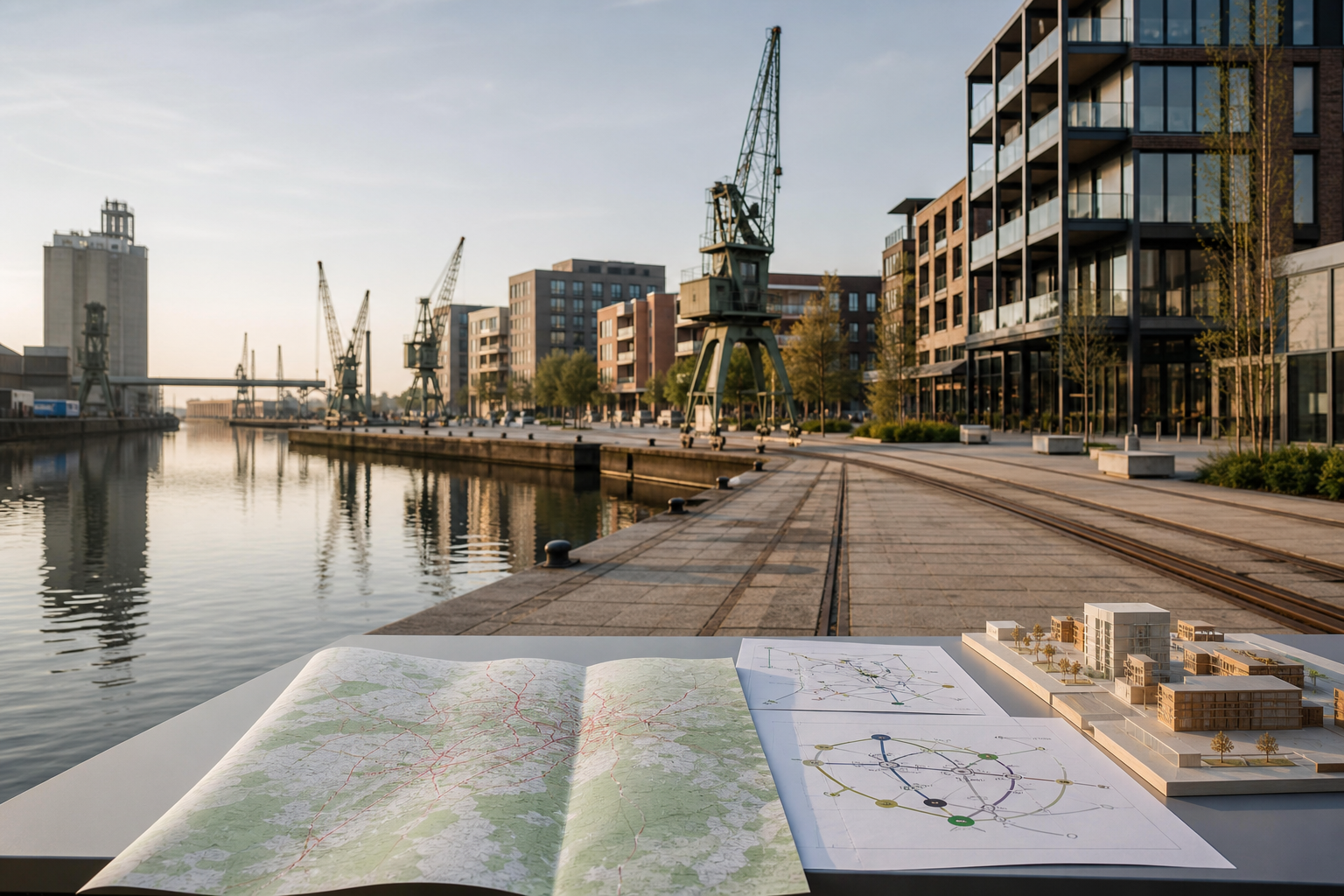
In addition to the European projects, a second topic came to the fore in Münster: the transformation of the harbor area. The delegations dealt with the change from an industrial area to a residential, work and leisure quarter. During a tour, the guests got an impression of the promenade being created on the south side; special interest was given to the plans for model quarters around the Dortmund-Ems Canal, developed in dialogue with the urban community.
This program point in particular shows how MONT works in practice: Urban development becomes a joint learning field because many municipalities face similar goal conflicts – land pressure, climate adaptation, traffic, quality of stay and the connection of work, living and leisure. According to the city, the groundbreaking ceremony for the redesign of the south side of Stadthafen 1 between Hafenplatz and Dortmund-Ems Canal took place on August 20, 2024; a continuous, barrier-free promenade along the water is planned, while tracks and cranes are to be preserved as witnesses of the harbor's history.
What the change of chairmanship means politically
With the change of chairmanship to Hengelo, MONT continues its work without any recognizable change of course. The benchmark remains: Will it be possible to form permanently reliable cross-border structures from projects such as the Youth Capital application, the mobility cooperation and concrete examples of urban development? If this succeeds, the network will become more than a political commitment – namely an instrument that accelerates regional solutions and actually gives the border region more weight in Europe.
Frequently Asked Questions
Sources
- https://www.wirtschaft-aktuell.de/news/muenster-uebergibt-vorsitz-im-staedtenetzwerk-mont-an-hengelo
- https://www.muenster.de/pressemeldungen/web/frontend/design/kommunikation/show/1141310
- https://www.euregio.eu/de/aktuell/euregio-auf-shortlist-fuer-titel-european-youth-capital-2029/
- https://www.euregio.eu/de/wer-wir-sind/organisation/, 01.05.2026
- https://www.euregio.eu/de/wer-wir-sind/region-und-mitglieder/
- https://www.muenster.de/pressemeldungen/web/frontend/output/standard/search/1/design/standard_inc/page/35/show/1164596
- https://www.euregio.eu/de/aktuell/nachhaltige-verkehrsloesungen-ueber-die-grenze-mont-staedte-und-euregio-starten-mont-mobility/