
Potsdam
Am Neuen Palais, 14469 Potsdam, Deutschland
New Palace | Tickets & Opening Hours
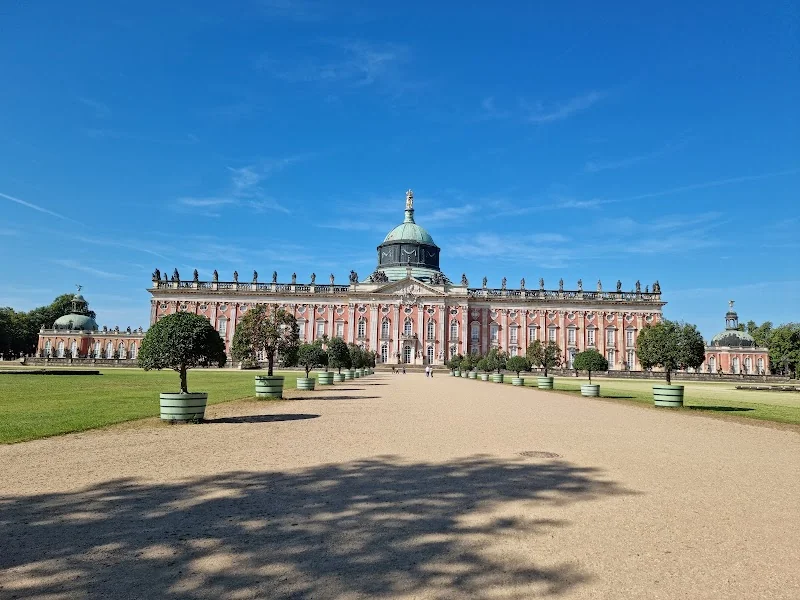
The New Palace in Potsdam is not an ordinary castle, but a monumental power and representation building at the western end of Sanssouci Park. It is considered the largest palace in the park, encompasses over 100 rooms, and is immediately recognizable from afar due to its high tambour dome. Today, visitors experience splendid festivity halls, richly furnished guest apartments, galleries, and the baroque castle theater of Sanssouci in an ensemble that not only tells the history of Prussia but also makes it spatially tangible. Sanssouci Park itself has been a UNESCO World Heritage Site since 1990, extends over almost 300 hectares, and, with more than 1000 sculptures, is one of the most significant garden landscapes in Europe. This combination of architecture, garden art, and courtly staging makes the New Palace one of the most impressive places to visit in Brandenburg. ([spsg.de](https://www.spsg.de/leichte-sprache/leichte-sprache-neues-palais?utm_source=openai))
Tickets, Opening Hours, and Online Booking
Those wishing to visit the New Palace should first pay attention to the seasonal opening hours, as the schedule is clearly regulated. From April to October, the palace is open from Monday and Wednesday to Sunday from 10:00 AM to 5:30 PM, and it is closed on Tuesdays. From November to April, visits are only possible with a guided tour. Additionally, the SPSG points out that holiday hours usually follow weekend hours, and the last admission is 30 minutes before closing time. Fixed entry times are scheduled for the visit, which is particularly important during the high season: tickets for the respective day are available at the visitor centers Historical Mill and New Palace, but due to limited daily quotas, early online booking is recommended. This interplay of time slots, ticket quotas, and seasonal access is crucial for planning, as spontaneous decisions on-site are not always the best option. ([spsg.de](https://www.spsg.de/schloesser-gaerten/objekt/neues-palais))
The ticket types are also transparently offered and tailored to different visiting forms. For the New Palace, there is the individual price Grand Tour, the individual price Prince Heinrich Apartment, a combination ticket Grand Tour / Prince Heinrich Apartment, as well as the ticket sanssouci+ and the family variant sanssouci+ Family. The SPSG states 14 euros for the Grand Tour, reduced 10 euros; for the Prince Heinrich Apartment 8 euros, reduced 6 euros; for the combination ticket 16 euros, reduced 14 euros; for sanssouci+ 22 euros, reduced 17 euros; and for sanssouci+ Family 49 euros. Those who wish to flexibly connect the Potsdam palaces in one day will find a good solution in the sanssouci+ ticket, as a fixed entry time in Sanssouci Palace and optionally additionally in the New Palace is booked upon purchase. This variant is particularly practical for families, as it covers up to two adults and up to four children. This ticket logic supports a targeted, well-prepared visitor experience instead of a hectic on-site decision. ([spsg.de](https://www.spsg.de/schloesser-gaerten/objekt/neues-palais))
It is also practical that the SPSG consolidates ticket sales not only online but also at the cash desks of the visitor centers. The visitor center New Palace serves as a service point for tickets, combination tickets, annual passes, and event tickets, thus facilitating both the preparation and the conclusion of the visit. For the search intent “new palace tickets,” not only the price is relevant, but also the question of where the tickets are available and how the timing is organized. The clear indication of fixed entry times and the limited daily number of tickets helps here, as it makes clear that the New Palace operates more like a curated museum visit than an open walk-in destination. Those who plan early have the best chance of getting the right slot and can combine the castle visit neatly with a tour through the park. ([spsg.de](https://www.spsg.de/schloesser-gaerten/objekt/besuchszentrum-neues-palais))
Visit, Tour, and Walk
The tour through the New Palace thrives on the contrasts between outer monumentality and inner delicacy. The SPSG describes the palace as a representation building, inside which magnificent festivity halls, grand galleries, and princely furnished apartments await. Particularly impressive is the restored area of the Lower Prince's Quarter with the Tressen Room, Concert Room, and Oval Cabinet, which is among the most precious interiors in Europe. The Grotto Hall has also been integrated back into the tour after renovation and shows exactly that mix of glitter, material splendor, and staging with which Frederick the Great wanted to impress his guests. For people with mobility restrictions, it is important to know that the ground floor is accessible via a lift and that two large festivity halls and various guest rooms from the time of Frederick the Great can be visited there. Thus, the visit remains experienceable even with restrictions, although not equally in all areas. ([spsg.de](https://www.spsg.de/schloesser-gaerten/objekt/neues-palais))
For groups, the SPSG states a tour duration of 75 minutes, and this number is also important for keyword planning, as many visitors search for the question “How long does the tour last?” The personal group tour is available in German and English, while the digital app tour of the New Palace also offers a clearly structured 75-minute tour. Additionally, the foundation for the New Palace provides various language versions in the SANSSOUCI app, including German, English, Italian, Spanish, French, Dutch, Polish, and Russian. This makes the palace suitable not only for traditionally guided groups but also for more individualized, self-determined visits with smartphones and headphones. For many guests, this mix is particularly attractive: a historic house with high-quality guidance, but at the same time with modern access that adapts to different types of visitors. ([spsg.de](https://www.spsg.de/gruppenangebote/die-gruppenangebote-auf-einen-blick/objekt/neues-palais?utm_source=openai))
A special plus for culture-interested visitors is the historic castle theater in the south wing. The SPSG emphasizes that it is one of the few remaining theaters from the 18th century and is regularly performed; at the same time, the amphitheater seating arrangement is highlighted, which fits the performance practice of the house. Thus, the New Palace expands its appeal far beyond mere architecture: it is not only a museum building but also a place of vibrant culture. So, those searching for “new palace visit” will not receive a narrow standard program here, but a wide range of spatial art, theater history, and courtly living culture. This makes the visit interesting for both first-time guests and repeat visitors, as the thematic levels are very different and a second visit can open up new perspectives. ([spsg.de](https://www.spsg.de/presse-foto-film/pressematerial-schloesser-gaerten-stiftung/potsdam/presse-material-neues-palais/))
Directions, Map, and Parking
The address of the New Palace is Am Neuen Palais, 14469 Potsdam. For arrival by public transport, the SPSG names the stop “Potsdam, Neues Palais”; additionally, the bus lines 605, 606, and 695 are mentioned in the accessibility-related visitor information. Those arriving by train benefit from the fact that there is an elevator at Potsdam-Sanssouci station, which facilitates access to the park area. For the search intent “new palace map,” it is particularly important that the visitor center serves as a point of orientation and that the paths to the park and the palace can be clearly described from there. The goal is not just any anonymous castle address, but a historically grown visitor area with fixed starting points. ([spsg.de](https://www.spsg.de/schloesser-gaerten/objekt/neues-palais))
Parking is also clearly regulated. For cars and buses, there are paid parking spaces at parking lot P3 – Am Neuen Palais. Additionally, the SPSG points out that there are disabled parking spaces at the parking lot of the University of Potsdam next to the visitor center. In Sanssouci Park, parking spaces P1 at the Historical Mill and P3 at the New Palace are also indicated. Therefore, those who want to plan their route leisurely should decide in advance whether the visit begins at the palace itself, at the visitor center, or at another park network point. Especially on heavily frequented days, this decision can improve the overall quality of the visit, as the walk through Sanssouci Park is certainly part of the experience and not just a mere route from A to B. ([spsg.de](https://www.spsg.de/schloesser-gaerten/objekt/neues-palais))
Particularly helpful is the free shuttle service that the SPSG offers daily from April to October from 11:00 AM to 5:30 PM on the Ökonomieweg between the Green Gate and the New Palace. The shuttle is made possible by volunteer drivers and is therefore not always available, which should be taken into account when planning routes. For visitors with limited mobility, however, this is an important component, as the path in the large park area can quickly become long otherwise. Additionally, the visitor center and the park itself provide orientation aids: an interactive touch table with a park model, a tactile bronze casting model in front of the building, and digital offerings with the SANSSOUCI app facilitate the overview. Thus, the search term “new palace map” becomes more than just a map; it becomes a whole visit strategy. ([spsg.de](https://www.spsg.de/schloesser-gaerten/barrierefreiheit-park-sanssouci))
Sanssouci Park itself is open daily from 8 AM until dusk and is freely accessible. This information is important because many visitors want to combine their castle visit with a walk in the park. The park covers nearly 300 hectares, is traversed by an over two-kilometer-long east-west axis, and unites various elevation levels, paths, and vistas. Therefore, those visiting the New Palace should plan enough time for the outdoor area, as the surroundings are not just a backdrop but part of the historical overall composition. This makes travel planning in Potsdam so special: one does not simply drive to a museum, but into a protected landscape that is already part of the visit. ([spsg.de](https://www.spsg.de/en/palaces-gardens/object/sanssouci-park))
History and Architecture of the New Palace
The New Palace was built between 1763 and 1769 on the orders of Frederick II and is considered the last palace that the king had built in his park. The SPSG describes the building as a demonstration of Prussian capability after the years of deprivation during the Seven Years' War. The official press material also emphasizes that the design is associated with the names Johann Gottfried Büring, Heinrich Ludwig Manger, Carl von Gontard, and Jean Laurant Legeay. Even these key data show that the New Palace was not conceived as a private retreat, but as a consciously publicly readable message: power, resilience, and representation were to be translated into stone. That Frederick the Great later resided in his royal apartment while guests and family members were accommodated in other areas fits exactly with this dual character of personal use and state staging. ([spsg.de](https://www.spsg.de/schloesser-gaerten/objekt/neues-palais))
Architecturally, the palace impresses mainly through its dimensions. The official press material states a length of 220 meters and more than 400 figures on the facade. At the same time, the SPSG highlights the prominently visible tambour with the large dome, which marks the palace from a distance. Inside, festivity halls, galleries, and richly furnished living rooms continue the outer grand form. This combination is a central feature of the house: externally, it is strictly monumental, internally surprisingly diverse and decorative. Particularly the castle theater in the south wing, the grand marble hall and grotto hall staging, as well as the princely rooms show that here not only was built but consciously composed. The building is thus a model example of Frederickian court architecture, where architectural language is directly linked to political statement. ([spsg.de](https://www.spsg.de/presse-foto-film/pressematerial-schloesser-gaerten-stiftung/potsdam/presse-material-neues-palais/))
The usage history of the New Palace is also remarkable. Later, it was regularly inhabited by Emperor Frederick III during the summer, and Emperor Wilhelm II designated it as his main residence; after the monarchical period, the building was used as a museum. According to the SPSG, the New Palace has been used as a museum since 1926, which explains its current role as a publicly accessible cultural site. In the immediate vicinity are the Communs, which previously served as economic buildings and are now used by the University of Potsdam. Thus, court history, university life, and monument protection overlap in an unusual way at the New Palace. These layers give the place a special tension: it is not only a monument of the past but also a space that continues to have an impact on the present. ([spsg.de](https://www.spsg.de/presse-foto-film/pressematerial-schloesser-gaerten-stiftung/potsdam/presse-material-neues-palais/))
Another important context is Sanssouci Park itself. It was added to the UNESCO World Heritage List in 1990 and combines French garden art, landscape extensions from the 19th century, and monumental architecture into one of the most significant garden ensembles in Europe. The SPSG refers to over 1000 sculptures in the park and the nearly 300-hectare area. The New Palace stands at the western end of this long axis of views and paths and serves as the triumphant keystone of the overall plan. Therefore, those visiting the palace should not only pay attention to the interiors but also consider the spatial integration into the landscape. This connection of axis, garden, visual relationship, and building form is one of the reasons why the New Palace is regarded as a key site of Prussian cultural history far beyond Potsdam. ([spsg.de](https://www.spsg.de/en/palaces-gardens/object/sanssouci-park))
Visitor Center and Accessible Visit
A particularly important component for a successful visit is the visitor center New Palace in the South Gate building. The SPSG describes it as a place where one can prepare for or conclude the visit to the palace and Sanssouci Park. There are tickets including combination tickets and annual passes, a museum shop with books and products on the history of Prussia, Café Caroline for a break with coffee and snacks, and a relaxation room. Additionally, there is an interactive touch table with maps and background information about Sanssouci Park and a barrier-free bronze casting model that allows for tactile exploration of the park. The building itself was constructed in 1768/69 according to a design by Carl von Gontard as a guard building for the New Palace, was later used in various ways, and was reopened as a visitor center in 2013 after renovation. Thus, the place connects historical substance with modern visitor logistics. ([spsg.de](https://www.spsg.de/schloesser-gaerten/objekt/besuchszentrum-neues-palais))
For visitors with mobility restrictions, there are specific aids at the New Palace. The SPSG points out that the ground floor is accessible via a lift, and there, two large festivity halls and various guest rooms from the time of Frederick the Great can be visited. At the same time, the foundation asks groups with more than two wheelchair users to register in advance, as there is often little room to move in many palace rooms. The location of the visitor center, the accessible restrooms, free Wi-Fi, and orientation aids make it clear that the visit is organized as inclusively as possible, even if the historical building fabric cannot be barrier-free in every area. Therefore, anyone planning a visit should not only consider the route but also their own needs and, if necessary, contact in advance. ([spsg.de](https://www.spsg.de/schloesser-gaerten/angebote-fuer-gaeste-mit-handicap/barrierefreiheit/mobilitaetseinschraenkungen/park-sanssouci/neues-palais))
Digital preparation also pays off. The SANSSOUCI app is the official companion for palace and park visits and can be downloaded for free. Several language versions are available for the New Palace, and the SPSG recommends loading the content before the visit, as there may be difficulties with Wi-Fi usage in the building depending on the structural situation. Those who use the app with their own headphones are more flexible on-site and can complement the tour at their own pace. Together with the visitor center, the map, and the clear indications regarding tickets and arrival, a very well-structured visit process emerges. Especially at such a large and historically dense place like the New Palace, this preparation is a real advantage as it saves time and keeps the mind free for the essentials: architecture, history, and atmosphere. ([spsg.de](https://www.spsg.de/gruppenangebote/die-gruppenangebote-auf-einen-blick/objekt/neues-palais?utm_source=openai))
Sources:
Show moreShow less
New Palace | Tickets & Opening Hours
The New Palace in Potsdam is not an ordinary castle, but a monumental power and representation building at the western end of Sanssouci Park. It is considered the largest palace in the park, encompasses over 100 rooms, and is immediately recognizable from afar due to its high tambour dome. Today, visitors experience splendid festivity halls, richly furnished guest apartments, galleries, and the baroque castle theater of Sanssouci in an ensemble that not only tells the history of Prussia but also makes it spatially tangible. Sanssouci Park itself has been a UNESCO World Heritage Site since 1990, extends over almost 300 hectares, and, with more than 1000 sculptures, is one of the most significant garden landscapes in Europe. This combination of architecture, garden art, and courtly staging makes the New Palace one of the most impressive places to visit in Brandenburg. ([spsg.de](https://www.spsg.de/leichte-sprache/leichte-sprache-neues-palais?utm_source=openai))
Tickets, Opening Hours, and Online Booking
Those wishing to visit the New Palace should first pay attention to the seasonal opening hours, as the schedule is clearly regulated. From April to October, the palace is open from Monday and Wednesday to Sunday from 10:00 AM to 5:30 PM, and it is closed on Tuesdays. From November to April, visits are only possible with a guided tour. Additionally, the SPSG points out that holiday hours usually follow weekend hours, and the last admission is 30 minutes before closing time. Fixed entry times are scheduled for the visit, which is particularly important during the high season: tickets for the respective day are available at the visitor centers Historical Mill and New Palace, but due to limited daily quotas, early online booking is recommended. This interplay of time slots, ticket quotas, and seasonal access is crucial for planning, as spontaneous decisions on-site are not always the best option. ([spsg.de](https://www.spsg.de/schloesser-gaerten/objekt/neues-palais))
The ticket types are also transparently offered and tailored to different visiting forms. For the New Palace, there is the individual price Grand Tour, the individual price Prince Heinrich Apartment, a combination ticket Grand Tour / Prince Heinrich Apartment, as well as the ticket sanssouci+ and the family variant sanssouci+ Family. The SPSG states 14 euros for the Grand Tour, reduced 10 euros; for the Prince Heinrich Apartment 8 euros, reduced 6 euros; for the combination ticket 16 euros, reduced 14 euros; for sanssouci+ 22 euros, reduced 17 euros; and for sanssouci+ Family 49 euros. Those who wish to flexibly connect the Potsdam palaces in one day will find a good solution in the sanssouci+ ticket, as a fixed entry time in Sanssouci Palace and optionally additionally in the New Palace is booked upon purchase. This variant is particularly practical for families, as it covers up to two adults and up to four children. This ticket logic supports a targeted, well-prepared visitor experience instead of a hectic on-site decision. ([spsg.de](https://www.spsg.de/schloesser-gaerten/objekt/neues-palais))
It is also practical that the SPSG consolidates ticket sales not only online but also at the cash desks of the visitor centers. The visitor center New Palace serves as a service point for tickets, combination tickets, annual passes, and event tickets, thus facilitating both the preparation and the conclusion of the visit. For the search intent “new palace tickets,” not only the price is relevant, but also the question of where the tickets are available and how the timing is organized. The clear indication of fixed entry times and the limited daily number of tickets helps here, as it makes clear that the New Palace operates more like a curated museum visit than an open walk-in destination. Those who plan early have the best chance of getting the right slot and can combine the castle visit neatly with a tour through the park. ([spsg.de](https://www.spsg.de/schloesser-gaerten/objekt/besuchszentrum-neues-palais))
Visit, Tour, and Walk
The tour through the New Palace thrives on the contrasts between outer monumentality and inner delicacy. The SPSG describes the palace as a representation building, inside which magnificent festivity halls, grand galleries, and princely furnished apartments await. Particularly impressive is the restored area of the Lower Prince's Quarter with the Tressen Room, Concert Room, and Oval Cabinet, which is among the most precious interiors in Europe. The Grotto Hall has also been integrated back into the tour after renovation and shows exactly that mix of glitter, material splendor, and staging with which Frederick the Great wanted to impress his guests. For people with mobility restrictions, it is important to know that the ground floor is accessible via a lift and that two large festivity halls and various guest rooms from the time of Frederick the Great can be visited there. Thus, the visit remains experienceable even with restrictions, although not equally in all areas. ([spsg.de](https://www.spsg.de/schloesser-gaerten/objekt/neues-palais))
For groups, the SPSG states a tour duration of 75 minutes, and this number is also important for keyword planning, as many visitors search for the question “How long does the tour last?” The personal group tour is available in German and English, while the digital app tour of the New Palace also offers a clearly structured 75-minute tour. Additionally, the foundation for the New Palace provides various language versions in the SANSSOUCI app, including German, English, Italian, Spanish, French, Dutch, Polish, and Russian. This makes the palace suitable not only for traditionally guided groups but also for more individualized, self-determined visits with smartphones and headphones. For many guests, this mix is particularly attractive: a historic house with high-quality guidance, but at the same time with modern access that adapts to different types of visitors. ([spsg.de](https://www.spsg.de/gruppenangebote/die-gruppenangebote-auf-einen-blick/objekt/neues-palais?utm_source=openai))
A special plus for culture-interested visitors is the historic castle theater in the south wing. The SPSG emphasizes that it is one of the few remaining theaters from the 18th century and is regularly performed; at the same time, the amphitheater seating arrangement is highlighted, which fits the performance practice of the house. Thus, the New Palace expands its appeal far beyond mere architecture: it is not only a museum building but also a place of vibrant culture. So, those searching for “new palace visit” will not receive a narrow standard program here, but a wide range of spatial art, theater history, and courtly living culture. This makes the visit interesting for both first-time guests and repeat visitors, as the thematic levels are very different and a second visit can open up new perspectives. ([spsg.de](https://www.spsg.de/presse-foto-film/pressematerial-schloesser-gaerten-stiftung/potsdam/presse-material-neues-palais/))
Directions, Map, and Parking
The address of the New Palace is Am Neuen Palais, 14469 Potsdam. For arrival by public transport, the SPSG names the stop “Potsdam, Neues Palais”; additionally, the bus lines 605, 606, and 695 are mentioned in the accessibility-related visitor information. Those arriving by train benefit from the fact that there is an elevator at Potsdam-Sanssouci station, which facilitates access to the park area. For the search intent “new palace map,” it is particularly important that the visitor center serves as a point of orientation and that the paths to the park and the palace can be clearly described from there. The goal is not just any anonymous castle address, but a historically grown visitor area with fixed starting points. ([spsg.de](https://www.spsg.de/schloesser-gaerten/objekt/neues-palais))
Parking is also clearly regulated. For cars and buses, there are paid parking spaces at parking lot P3 – Am Neuen Palais. Additionally, the SPSG points out that there are disabled parking spaces at the parking lot of the University of Potsdam next to the visitor center. In Sanssouci Park, parking spaces P1 at the Historical Mill and P3 at the New Palace are also indicated. Therefore, those who want to plan their route leisurely should decide in advance whether the visit begins at the palace itself, at the visitor center, or at another park network point. Especially on heavily frequented days, this decision can improve the overall quality of the visit, as the walk through Sanssouci Park is certainly part of the experience and not just a mere route from A to B. ([spsg.de](https://www.spsg.de/schloesser-gaerten/objekt/neues-palais))
Particularly helpful is the free shuttle service that the SPSG offers daily from April to October from 11:00 AM to 5:30 PM on the Ökonomieweg between the Green Gate and the New Palace. The shuttle is made possible by volunteer drivers and is therefore not always available, which should be taken into account when planning routes. For visitors with limited mobility, however, this is an important component, as the path in the large park area can quickly become long otherwise. Additionally, the visitor center and the park itself provide orientation aids: an interactive touch table with a park model, a tactile bronze casting model in front of the building, and digital offerings with the SANSSOUCI app facilitate the overview. Thus, the search term “new palace map” becomes more than just a map; it becomes a whole visit strategy. ([spsg.de](https://www.spsg.de/schloesser-gaerten/barrierefreiheit-park-sanssouci))
Sanssouci Park itself is open daily from 8 AM until dusk and is freely accessible. This information is important because many visitors want to combine their castle visit with a walk in the park. The park covers nearly 300 hectares, is traversed by an over two-kilometer-long east-west axis, and unites various elevation levels, paths, and vistas. Therefore, those visiting the New Palace should plan enough time for the outdoor area, as the surroundings are not just a backdrop but part of the historical overall composition. This makes travel planning in Potsdam so special: one does not simply drive to a museum, but into a protected landscape that is already part of the visit. ([spsg.de](https://www.spsg.de/en/palaces-gardens/object/sanssouci-park))
History and Architecture of the New Palace
The New Palace was built between 1763 and 1769 on the orders of Frederick II and is considered the last palace that the king had built in his park. The SPSG describes the building as a demonstration of Prussian capability after the years of deprivation during the Seven Years' War. The official press material also emphasizes that the design is associated with the names Johann Gottfried Büring, Heinrich Ludwig Manger, Carl von Gontard, and Jean Laurant Legeay. Even these key data show that the New Palace was not conceived as a private retreat, but as a consciously publicly readable message: power, resilience, and representation were to be translated into stone. That Frederick the Great later resided in his royal apartment while guests and family members were accommodated in other areas fits exactly with this dual character of personal use and state staging. ([spsg.de](https://www.spsg.de/schloesser-gaerten/objekt/neues-palais))
Architecturally, the palace impresses mainly through its dimensions. The official press material states a length of 220 meters and more than 400 figures on the facade. At the same time, the SPSG highlights the prominently visible tambour with the large dome, which marks the palace from a distance. Inside, festivity halls, galleries, and richly furnished living rooms continue the outer grand form. This combination is a central feature of the house: externally, it is strictly monumental, internally surprisingly diverse and decorative. Particularly the castle theater in the south wing, the grand marble hall and grotto hall staging, as well as the princely rooms show that here not only was built but consciously composed. The building is thus a model example of Frederickian court architecture, where architectural language is directly linked to political statement. ([spsg.de](https://www.spsg.de/presse-foto-film/pressematerial-schloesser-gaerten-stiftung/potsdam/presse-material-neues-palais/))
The usage history of the New Palace is also remarkable. Later, it was regularly inhabited by Emperor Frederick III during the summer, and Emperor Wilhelm II designated it as his main residence; after the monarchical period, the building was used as a museum. According to the SPSG, the New Palace has been used as a museum since 1926, which explains its current role as a publicly accessible cultural site. In the immediate vicinity are the Communs, which previously served as economic buildings and are now used by the University of Potsdam. Thus, court history, university life, and monument protection overlap in an unusual way at the New Palace. These layers give the place a special tension: it is not only a monument of the past but also a space that continues to have an impact on the present. ([spsg.de](https://www.spsg.de/presse-foto-film/pressematerial-schloesser-gaerten-stiftung/potsdam/presse-material-neues-palais/))
Another important context is Sanssouci Park itself. It was added to the UNESCO World Heritage List in 1990 and combines French garden art, landscape extensions from the 19th century, and monumental architecture into one of the most significant garden ensembles in Europe. The SPSG refers to over 1000 sculptures in the park and the nearly 300-hectare area. The New Palace stands at the western end of this long axis of views and paths and serves as the triumphant keystone of the overall plan. Therefore, those visiting the palace should not only pay attention to the interiors but also consider the spatial integration into the landscape. This connection of axis, garden, visual relationship, and building form is one of the reasons why the New Palace is regarded as a key site of Prussian cultural history far beyond Potsdam. ([spsg.de](https://www.spsg.de/en/palaces-gardens/object/sanssouci-park))
Visitor Center and Accessible Visit
A particularly important component for a successful visit is the visitor center New Palace in the South Gate building. The SPSG describes it as a place where one can prepare for or conclude the visit to the palace and Sanssouci Park. There are tickets including combination tickets and annual passes, a museum shop with books and products on the history of Prussia, Café Caroline for a break with coffee and snacks, and a relaxation room. Additionally, there is an interactive touch table with maps and background information about Sanssouci Park and a barrier-free bronze casting model that allows for tactile exploration of the park. The building itself was constructed in 1768/69 according to a design by Carl von Gontard as a guard building for the New Palace, was later used in various ways, and was reopened as a visitor center in 2013 after renovation. Thus, the place connects historical substance with modern visitor logistics. ([spsg.de](https://www.spsg.de/schloesser-gaerten/objekt/besuchszentrum-neues-palais))
For visitors with mobility restrictions, there are specific aids at the New Palace. The SPSG points out that the ground floor is accessible via a lift, and there, two large festivity halls and various guest rooms from the time of Frederick the Great can be visited. At the same time, the foundation asks groups with more than two wheelchair users to register in advance, as there is often little room to move in many palace rooms. The location of the visitor center, the accessible restrooms, free Wi-Fi, and orientation aids make it clear that the visit is organized as inclusively as possible, even if the historical building fabric cannot be barrier-free in every area. Therefore, anyone planning a visit should not only consider the route but also their own needs and, if necessary, contact in advance. ([spsg.de](https://www.spsg.de/schloesser-gaerten/angebote-fuer-gaeste-mit-handicap/barrierefreiheit/mobilitaetseinschraenkungen/park-sanssouci/neues-palais))
Digital preparation also pays off. The SANSSOUCI app is the official companion for palace and park visits and can be downloaded for free. Several language versions are available for the New Palace, and the SPSG recommends loading the content before the visit, as there may be difficulties with Wi-Fi usage in the building depending on the structural situation. Those who use the app with their own headphones are more flexible on-site and can complement the tour at their own pace. Together with the visitor center, the map, and the clear indications regarding tickets and arrival, a very well-structured visit process emerges. Especially at such a large and historically dense place like the New Palace, this preparation is a real advantage as it saves time and keeps the mind free for the essentials: architecture, history, and atmosphere. ([spsg.de](https://www.spsg.de/gruppenangebote/die-gruppenangebote-auf-einen-blick/objekt/neues-palais?utm_source=openai))
Sources:
New Palace | Tickets & Opening Hours
The New Palace in Potsdam is not an ordinary castle, but a monumental power and representation building at the western end of Sanssouci Park. It is considered the largest palace in the park, encompasses over 100 rooms, and is immediately recognizable from afar due to its high tambour dome. Today, visitors experience splendid festivity halls, richly furnished guest apartments, galleries, and the baroque castle theater of Sanssouci in an ensemble that not only tells the history of Prussia but also makes it spatially tangible. Sanssouci Park itself has been a UNESCO World Heritage Site since 1990, extends over almost 300 hectares, and, with more than 1000 sculptures, is one of the most significant garden landscapes in Europe. This combination of architecture, garden art, and courtly staging makes the New Palace one of the most impressive places to visit in Brandenburg. ([spsg.de](https://www.spsg.de/leichte-sprache/leichte-sprache-neues-palais?utm_source=openai))
Tickets, Opening Hours, and Online Booking
Those wishing to visit the New Palace should first pay attention to the seasonal opening hours, as the schedule is clearly regulated. From April to October, the palace is open from Monday and Wednesday to Sunday from 10:00 AM to 5:30 PM, and it is closed on Tuesdays. From November to April, visits are only possible with a guided tour. Additionally, the SPSG points out that holiday hours usually follow weekend hours, and the last admission is 30 minutes before closing time. Fixed entry times are scheduled for the visit, which is particularly important during the high season: tickets for the respective day are available at the visitor centers Historical Mill and New Palace, but due to limited daily quotas, early online booking is recommended. This interplay of time slots, ticket quotas, and seasonal access is crucial for planning, as spontaneous decisions on-site are not always the best option. ([spsg.de](https://www.spsg.de/schloesser-gaerten/objekt/neues-palais))
The ticket types are also transparently offered and tailored to different visiting forms. For the New Palace, there is the individual price Grand Tour, the individual price Prince Heinrich Apartment, a combination ticket Grand Tour / Prince Heinrich Apartment, as well as the ticket sanssouci+ and the family variant sanssouci+ Family. The SPSG states 14 euros for the Grand Tour, reduced 10 euros; for the Prince Heinrich Apartment 8 euros, reduced 6 euros; for the combination ticket 16 euros, reduced 14 euros; for sanssouci+ 22 euros, reduced 17 euros; and for sanssouci+ Family 49 euros. Those who wish to flexibly connect the Potsdam palaces in one day will find a good solution in the sanssouci+ ticket, as a fixed entry time in Sanssouci Palace and optionally additionally in the New Palace is booked upon purchase. This variant is particularly practical for families, as it covers up to two adults and up to four children. This ticket logic supports a targeted, well-prepared visitor experience instead of a hectic on-site decision. ([spsg.de](https://www.spsg.de/schloesser-gaerten/objekt/neues-palais))
It is also practical that the SPSG consolidates ticket sales not only online but also at the cash desks of the visitor centers. The visitor center New Palace serves as a service point for tickets, combination tickets, annual passes, and event tickets, thus facilitating both the preparation and the conclusion of the visit. For the search intent “new palace tickets,” not only the price is relevant, but also the question of where the tickets are available and how the timing is organized. The clear indication of fixed entry times and the limited daily number of tickets helps here, as it makes clear that the New Palace operates more like a curated museum visit than an open walk-in destination. Those who plan early have the best chance of getting the right slot and can combine the castle visit neatly with a tour through the park. ([spsg.de](https://www.spsg.de/schloesser-gaerten/objekt/besuchszentrum-neues-palais))
Visit, Tour, and Walk
The tour through the New Palace thrives on the contrasts between outer monumentality and inner delicacy. The SPSG describes the palace as a representation building, inside which magnificent festivity halls, grand galleries, and princely furnished apartments await. Particularly impressive is the restored area of the Lower Prince's Quarter with the Tressen Room, Concert Room, and Oval Cabinet, which is among the most precious interiors in Europe. The Grotto Hall has also been integrated back into the tour after renovation and shows exactly that mix of glitter, material splendor, and staging with which Frederick the Great wanted to impress his guests. For people with mobility restrictions, it is important to know that the ground floor is accessible via a lift and that two large festivity halls and various guest rooms from the time of Frederick the Great can be visited there. Thus, the visit remains experienceable even with restrictions, although not equally in all areas. ([spsg.de](https://www.spsg.de/schloesser-gaerten/objekt/neues-palais))
For groups, the SPSG states a tour duration of 75 minutes, and this number is also important for keyword planning, as many visitors search for the question “How long does the tour last?” The personal group tour is available in German and English, while the digital app tour of the New Palace also offers a clearly structured 75-minute tour. Additionally, the foundation for the New Palace provides various language versions in the SANSSOUCI app, including German, English, Italian, Spanish, French, Dutch, Polish, and Russian. This makes the palace suitable not only for traditionally guided groups but also for more individualized, self-determined visits with smartphones and headphones. For many guests, this mix is particularly attractive: a historic house with high-quality guidance, but at the same time with modern access that adapts to different types of visitors. ([spsg.de](https://www.spsg.de/gruppenangebote/die-gruppenangebote-auf-einen-blick/objekt/neues-palais?utm_source=openai))
A special plus for culture-interested visitors is the historic castle theater in the south wing. The SPSG emphasizes that it is one of the few remaining theaters from the 18th century and is regularly performed; at the same time, the amphitheater seating arrangement is highlighted, which fits the performance practice of the house. Thus, the New Palace expands its appeal far beyond mere architecture: it is not only a museum building but also a place of vibrant culture. So, those searching for “new palace visit” will not receive a narrow standard program here, but a wide range of spatial art, theater history, and courtly living culture. This makes the visit interesting for both first-time guests and repeat visitors, as the thematic levels are very different and a second visit can open up new perspectives. ([spsg.de](https://www.spsg.de/presse-foto-film/pressematerial-schloesser-gaerten-stiftung/potsdam/presse-material-neues-palais/))
Directions, Map, and Parking
The address of the New Palace is Am Neuen Palais, 14469 Potsdam. For arrival by public transport, the SPSG names the stop “Potsdam, Neues Palais”; additionally, the bus lines 605, 606, and 695 are mentioned in the accessibility-related visitor information. Those arriving by train benefit from the fact that there is an elevator at Potsdam-Sanssouci station, which facilitates access to the park area. For the search intent “new palace map,” it is particularly important that the visitor center serves as a point of orientation and that the paths to the park and the palace can be clearly described from there. The goal is not just any anonymous castle address, but a historically grown visitor area with fixed starting points. ([spsg.de](https://www.spsg.de/schloesser-gaerten/objekt/neues-palais))
Parking is also clearly regulated. For cars and buses, there are paid parking spaces at parking lot P3 – Am Neuen Palais. Additionally, the SPSG points out that there are disabled parking spaces at the parking lot of the University of Potsdam next to the visitor center. In Sanssouci Park, parking spaces P1 at the Historical Mill and P3 at the New Palace are also indicated. Therefore, those who want to plan their route leisurely should decide in advance whether the visit begins at the palace itself, at the visitor center, or at another park network point. Especially on heavily frequented days, this decision can improve the overall quality of the visit, as the walk through Sanssouci Park is certainly part of the experience and not just a mere route from A to B. ([spsg.de](https://www.spsg.de/schloesser-gaerten/objekt/neues-palais))
Particularly helpful is the free shuttle service that the SPSG offers daily from April to October from 11:00 AM to 5:30 PM on the Ökonomieweg between the Green Gate and the New Palace. The shuttle is made possible by volunteer drivers and is therefore not always available, which should be taken into account when planning routes. For visitors with limited mobility, however, this is an important component, as the path in the large park area can quickly become long otherwise. Additionally, the visitor center and the park itself provide orientation aids: an interactive touch table with a park model, a tactile bronze casting model in front of the building, and digital offerings with the SANSSOUCI app facilitate the overview. Thus, the search term “new palace map” becomes more than just a map; it becomes a whole visit strategy. ([spsg.de](https://www.spsg.de/schloesser-gaerten/barrierefreiheit-park-sanssouci))
Sanssouci Park itself is open daily from 8 AM until dusk and is freely accessible. This information is important because many visitors want to combine their castle visit with a walk in the park. The park covers nearly 300 hectares, is traversed by an over two-kilometer-long east-west axis, and unites various elevation levels, paths, and vistas. Therefore, those visiting the New Palace should plan enough time for the outdoor area, as the surroundings are not just a backdrop but part of the historical overall composition. This makes travel planning in Potsdam so special: one does not simply drive to a museum, but into a protected landscape that is already part of the visit. ([spsg.de](https://www.spsg.de/en/palaces-gardens/object/sanssouci-park))
History and Architecture of the New Palace
The New Palace was built between 1763 and 1769 on the orders of Frederick II and is considered the last palace that the king had built in his park. The SPSG describes the building as a demonstration of Prussian capability after the years of deprivation during the Seven Years' War. The official press material also emphasizes that the design is associated with the names Johann Gottfried Büring, Heinrich Ludwig Manger, Carl von Gontard, and Jean Laurant Legeay. Even these key data show that the New Palace was not conceived as a private retreat, but as a consciously publicly readable message: power, resilience, and representation were to be translated into stone. That Frederick the Great later resided in his royal apartment while guests and family members were accommodated in other areas fits exactly with this dual character of personal use and state staging. ([spsg.de](https://www.spsg.de/schloesser-gaerten/objekt/neues-palais))
Architecturally, the palace impresses mainly through its dimensions. The official press material states a length of 220 meters and more than 400 figures on the facade. At the same time, the SPSG highlights the prominently visible tambour with the large dome, which marks the palace from a distance. Inside, festivity halls, galleries, and richly furnished living rooms continue the outer grand form. This combination is a central feature of the house: externally, it is strictly monumental, internally surprisingly diverse and decorative. Particularly the castle theater in the south wing, the grand marble hall and grotto hall staging, as well as the princely rooms show that here not only was built but consciously composed. The building is thus a model example of Frederickian court architecture, where architectural language is directly linked to political statement. ([spsg.de](https://www.spsg.de/presse-foto-film/pressematerial-schloesser-gaerten-stiftung/potsdam/presse-material-neues-palais/))
The usage history of the New Palace is also remarkable. Later, it was regularly inhabited by Emperor Frederick III during the summer, and Emperor Wilhelm II designated it as his main residence; after the monarchical period, the building was used as a museum. According to the SPSG, the New Palace has been used as a museum since 1926, which explains its current role as a publicly accessible cultural site. In the immediate vicinity are the Communs, which previously served as economic buildings and are now used by the University of Potsdam. Thus, court history, university life, and monument protection overlap in an unusual way at the New Palace. These layers give the place a special tension: it is not only a monument of the past but also a space that continues to have an impact on the present. ([spsg.de](https://www.spsg.de/presse-foto-film/pressematerial-schloesser-gaerten-stiftung/potsdam/presse-material-neues-palais/))
Another important context is Sanssouci Park itself. It was added to the UNESCO World Heritage List in 1990 and combines French garden art, landscape extensions from the 19th century, and monumental architecture into one of the most significant garden ensembles in Europe. The SPSG refers to over 1000 sculptures in the park and the nearly 300-hectare area. The New Palace stands at the western end of this long axis of views and paths and serves as the triumphant keystone of the overall plan. Therefore, those visiting the palace should not only pay attention to the interiors but also consider the spatial integration into the landscape. This connection of axis, garden, visual relationship, and building form is one of the reasons why the New Palace is regarded as a key site of Prussian cultural history far beyond Potsdam. ([spsg.de](https://www.spsg.de/en/palaces-gardens/object/sanssouci-park))
Visitor Center and Accessible Visit
A particularly important component for a successful visit is the visitor center New Palace in the South Gate building. The SPSG describes it as a place where one can prepare for or conclude the visit to the palace and Sanssouci Park. There are tickets including combination tickets and annual passes, a museum shop with books and products on the history of Prussia, Café Caroline for a break with coffee and snacks, and a relaxation room. Additionally, there is an interactive touch table with maps and background information about Sanssouci Park and a barrier-free bronze casting model that allows for tactile exploration of the park. The building itself was constructed in 1768/69 according to a design by Carl von Gontard as a guard building for the New Palace, was later used in various ways, and was reopened as a visitor center in 2013 after renovation. Thus, the place connects historical substance with modern visitor logistics. ([spsg.de](https://www.spsg.de/schloesser-gaerten/objekt/besuchszentrum-neues-palais))
For visitors with mobility restrictions, there are specific aids at the New Palace. The SPSG points out that the ground floor is accessible via a lift, and there, two large festivity halls and various guest rooms from the time of Frederick the Great can be visited. At the same time, the foundation asks groups with more than two wheelchair users to register in advance, as there is often little room to move in many palace rooms. The location of the visitor center, the accessible restrooms, free Wi-Fi, and orientation aids make it clear that the visit is organized as inclusively as possible, even if the historical building fabric cannot be barrier-free in every area. Therefore, anyone planning a visit should not only consider the route but also their own needs and, if necessary, contact in advance. ([spsg.de](https://www.spsg.de/schloesser-gaerten/angebote-fuer-gaeste-mit-handicap/barrierefreiheit/mobilitaetseinschraenkungen/park-sanssouci/neues-palais))
Digital preparation also pays off. The SANSSOUCI app is the official companion for palace and park visits and can be downloaded for free. Several language versions are available for the New Palace, and the SPSG recommends loading the content before the visit, as there may be difficulties with Wi-Fi usage in the building depending on the structural situation. Those who use the app with their own headphones are more flexible on-site and can complement the tour at their own pace. Together with the visitor center, the map, and the clear indications regarding tickets and arrival, a very well-structured visit process emerges. Especially at such a large and historically dense place like the New Palace, this preparation is a real advantage as it saves time and keeps the mind free for the essentials: architecture, history, and atmosphere. ([spsg.de](https://www.spsg.de/gruppenangebote/die-gruppenangebote-auf-einen-blick/objekt/neues-palais?utm_source=openai))
Sources:
Upcoming Events
No events found
Frequently Asked Questions
Reviews
Dylan King
10. November 2025
Worth noting this has been under restoration since the 80s and right now there is scaffolding on a large portion of the exterior. That's unfortunate but it's important to preserve it so it's a worthwhile trade. The 1hr tour of the interior is definitely worth it. They don't offer English tours which is unfortunate, but the guide would answer questions in English. There is an app that has multiple languages but it's nowhere near as detailed as the tour guide. I used Samsung AI interpreter to listen to what he was saying and while it wasn't perfect I got the general gist enough to ask some questions. He was very knowledgeable. The interior is stunning to match/exceed the exterior. To see it in the prime when operating would have been wild (albeit a bit gross I'm sure). The scaffolding should be off the front in the next few months but the restoration is never done. The university right next to the palace is also incredibly beautiful.
Sam
23. December 2025
We went in December, and after a long day we walked around this fantastic palace for hours. It is very scenic and very atmospheric in winter with the yellow lights and all the statues scattered around. We had another visit in summer and it was just as fantastic. A must visit.
Richard Jack
9. December 2025
Great to look through the royal palace and its intricacies. Furniture, flooring, walls and ceilings tell a story. The tour is in German so it is best to download the Sanssouci app before you go.
E C
20. December 2025
Definitely worth a visit. But be prepared to walk. We walked from Sanssouci to the New Palace and we were beat by the time we reached the new palace. Then we had to walk further to purchase tickets then walk back. Also they only do group tours.
Romain
15. November 2025
I visited the New Palace in winter, and as expected, the gardens looked a bit dull — perfectly normal for the season. What surprised me, though, was that all the statues were fully covered, so none of them could be seen. I understand the need for protection during colder months, but I was still hoping to experience a bit more of the place’s charm. Considering how beautiful and iconic this palace is, the visit felt slightly underwhelming.