
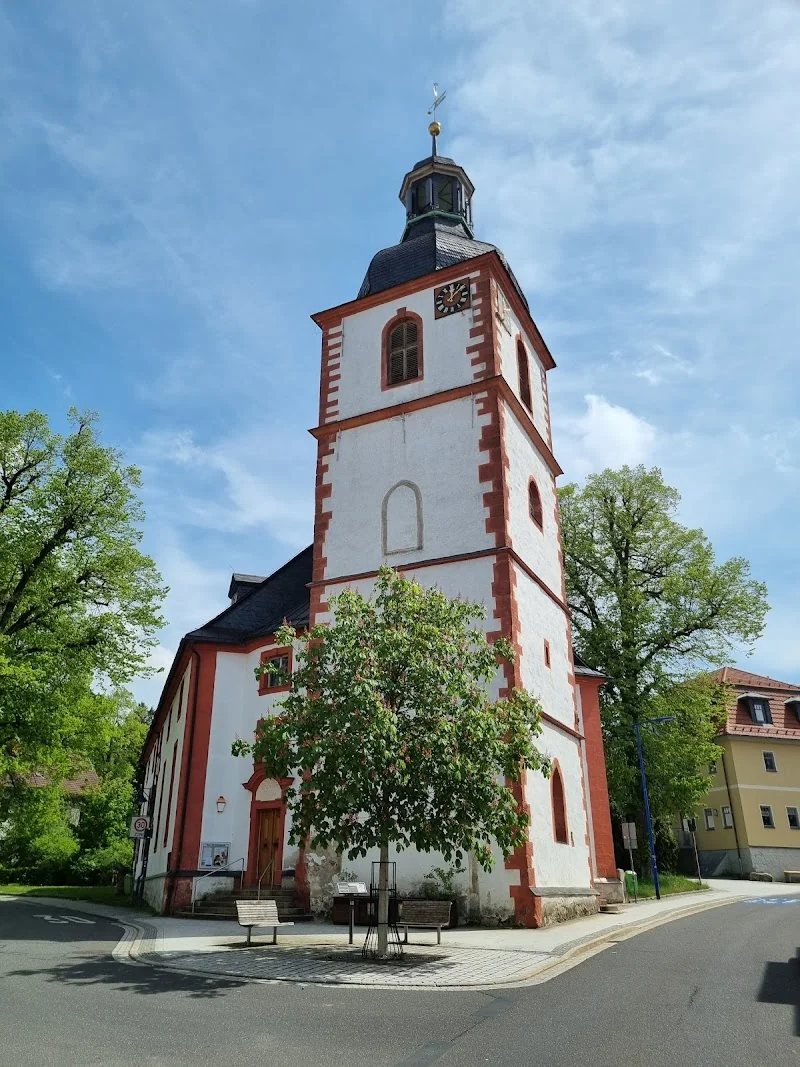
Kirchengemeinde, Hauptstraße 5, Zella-Mehlis
Kirchengemeinde, Hauptstraße 5, 98544 Zella-Mehlis, Germany
Magdalenenkirche in Mehlis | Events & Tickets
The Magdalenenkirche Mehlis is much more than a religious place on the edge of everyday life: it is a historical landmark, a vibrant meeting point for the church community, and a space for music, devotion, and quiet discoveries. The church is located on the main road of Mehlis, in present-day Zella-Mehlis, and shapes the townscape in a distinctive way with its simple, bright facade and its striking tower. The church community describes it as a house of God that radiates tranquility despite its proximity to traffic and is firmly rooted in community life. For visitors, it is particularly interesting that the Magdalenenkirche is not only used for worship services but also opens its doors for special events, exhibitions, and musical formats. Those looking for events or tickets will find here not a classic concert hall, but an authentic church space with cultural and spiritual use, where history and present are closely intertwined. The community also points out that the church is regularly open, allowing visitors to hear the organ or view a small exhibition. Thus, the Magdalenenkirche is a place worth visiting for both those with church interest and fans of culture and history. ([evangelische-kirche-zella-mehlis.de](https://www.evangelische-kirche-zella-mehlis.de/unsere-kirchen/magdalenenkirche/?utm_source=openai))
Events, Services, and Tickets at the Magdalenenkirche
Anyone interested in events at the Magdalenenkirche Mehlis should primarily keep an eye on the official dates of the church community. The current events page publishes regular community dates, musical offerings, and special worship services. These include, among other things, a musical devotion with communion at the Magdalenenkirche on Saturday, May 30, 2026, as well as other current dates in community life. The church music page also shows that the community specifically uses the Magdalenenkirche for musical worship services and church music formats. For example, the church is mentioned for services with instrumental church music, and a cantata service in the Magdalenenkirche is mentioned on the community's homepage. This shows: The church is not a static monument space but an active event venue with recurring program points. ([evangelische-kirche-zella-mehlis.de](https://www.evangelische-kirche-zella-mehlis.de/kirchengemeinde/termine-im-gemeindeleben/))
Regarding the search term tickets, it is important to remain realistic: The official website of the church community does not list a permanent ticket shop for the Magdalenenkirche. Instead, the page focuses on dates, worship services, church music, and direct contact with the parish office. This is plausible for a church, as many offerings are worship or community-oriented and not organized as classic ticket events. However, when special concerts, choir dates, or special devotions take place, it is always advisable to check the current event overview or make a direct inquiry at the parish office. The church community prominently displays a phone number and email address on its website for this purpose. So, those looking for tickets or reservations in a broader sense will find current information rather than a central booking system. This mix of open accessibility, cultural use, and church practice makes the place so interesting for inquiries about events and tickets. ([kirchenkreis-meiningen.de](https://www.kirchenkreis-meiningen.de/kirchengemeinden/zella-mehlis-oberhof/zella-mehlis/magdalenenkirche-in-mehlis/))
It is particularly helpful that the community not only publishes large individual dates but also makes the structure of community life visible. There are regular community afternoons, singing and making music at the Gildemeisterhaus, as well as church musical activities that repeatedly refer to the Magdalenenkirche. For visitors, this means: The Magdalenenkirche is part of a vibrant, locally grown culture and faith network. Those who are in Zella-Mehlis on a holiday or special occasion may encounter a musical or liturgical event that makes the church space newly experienceable. Those who plan early have the best chances of seeing suitable dates in time and clarifying any reservation questions directly with the community. ([evangelische-kirche-zella-mehlis.de](https://www.evangelische-kirche-zella-mehlis.de/kirchengemeinde/termine-im-gemeindeleben/))
The History of the Magdalenenkirche in Mehlis
The historical depth of the Magdalenenkirche is one of its strongest features. The official church website describes that the oldest preserved witness of a church at this site is the altar area on the ground floor of the tower. This part can be dated to the end of the 12th or the beginning of the 13th century. This means: The place itself is significantly older than the current church nave and reaches deep into the medieval history of the area. The community also refers to chronicles that suggest that by around 1190 almost every place in the area was supposed to have had a church. Although Mehlis is not directly mentioned, this hint shows how deeply the church tradition is rooted locally. For visitors, this is important because the Magdalenenkirche is not just a pretty old building but an architectural and religious continuity site over many centuries. ([evangelische-kirche-zella-mehlis.de](https://www.evangelische-kirche-zella-mehlis.de/unsere-kirchen/magdalenenkirche/))
The immediate predecessor church was built according to community information between 1621 and 1623 and was consecrated on October 17, 1623. This church was two stories high and combined solid masonry on the lower floor with timber framing on the upper part. Due to the growth of the community and the dilapidation of this predecessor building, planning for a new construction began in the early 18th century. On June 29, 1734, the foundation stone for the new church nave was laid, the shell and the slate roof were already completed the following year, and on Palm Sunday 1741 the church was consecrated. After that, the old church was demolished. The tower already received an increase of the bell chamber and the baroque dome and lantern in 1730. This clear, well-documented construction history makes the Magdalenenkirche a significant testimony to regional church and building history. It connects medieval remains, early modern transitions, and baroque building tradition in a single ensemble. ([evangelische-kirche-zella-mehlis.de](https://www.evangelische-kirche-zella-mehlis.de/unsere-kirchen/magdalenenkirche/))
The history of more recent times is also exciting. During a renovation in 1929 and 1930, the altar area on the ground floor of the tower was made visible again. In recent years, the tower has also been secured and restored, the church nave renewed on the outside, and the interiors gradually developed further. The church community emphasizes that work was done on the roof, exterior walls, and other building components for several years, involving various funding sources such as the city council of Zella-Mehlis, monument preservation, and foundations. These hints show that the Magdalenenkirche is not only preserved but actively maintained. Especially for visitors who appreciate historical churches, this is a good sign: The building is not a frozen museum object but a listed space that is kept alive. ([evangelische-kirche-zella-mehlis.de](https://www.evangelische-kirche-zella-mehlis.de/unsere-kirchen/magdalenenkirche/))
Architecture, Altar Area, and Organ
Architecturally, the Magdalenenkirche initially appears deliberately simple. The community describes it as an outwardly sober building without great ornamentation, with white walls and a long black slate roof. This restraint is precisely what gives the church its effect: it does not stand out due to overload but through calm, proportion, and presence. The tower grows wide and massive from the ground but does not dominate aggressively; rather, it marks the building as a spiritual center. Inside, the church connects the historical character with a clear spatial effect. Particularly interesting is that the altar area is located on the ground floor of the tower, thus forming a visible sign of the long construction history. When entering the space, one encounters not only a church space from the 18th century but also a structural memory that refers to even older times. ([evangelische-kirche-zella-mehlis.de](https://www.evangelische-kirche-zella-mehlis.de/unsere-kirchen/magdalenenkirche/))
Another central feature is the organ. The community writes that Johann Caspar Beck from Herrenbreitungen built an organ work in 1741, which was replaced in 1885 by a new one from Guido Knauf from Gotha and later modified several times. Today, the organ has 30 speaking stops, distributed over two manuals and a pedal. This is a remarkable feature for a church of this size and explains why the Magdalenenkirche is repeatedly used for musical worship services, organ moments, and special church music. That the middle part of the prospectus still comes from the organ of the predecessor church additionally shows how strongly historical layers intertwine here. According to the community, the carved, colored prospectus harmoniously integrates into the church nave and the vaulted ceiling. This connection of baroque spatial effect, older components, and later modifications makes the Magdalenenkirche so attractive for visitors interested in cultural history. ([evangelische-kirche-zella-mehlis.de](https://www.evangelische-kirche-zella-mehlis.de/unsere-kirchen/magdalenenkirche/))
The interior has also been described in the community and church district documentation as a place with interior furnishings from the 20th century. This does not mean that the historical character has been lost, but that the church has been adapted over time to new liturgical and technical requirements. This also includes renovations of the northeast wall and the installation of a heating system, which are explicitly mentioned in the church description. Such details are important for visitors because they show that the Magdalenenkirche is not only monumentally interesting but also remains functionally usable. The space continues to serve worship, music, and community life. This creates a tension field that characterizes many historical churches: they are, on the one hand, testimonies of past epochs, while on the other hand, they are places still filled with sound, light, warmth, and liturgy today. The Magdalenenkirche visibly and audibly fulfills this claim. ([kirchenkreis-meiningen.de](https://www.kirchenkreis-meiningen.de/kirchengemeinden/zella-mehlis-oberhof/zella-mehlis/magdalenenkirche-in-mehlis/))
Opening Hours, Tours, and Exhibitions at the Magdalenenkirche
Anyone wishing to experience the Magdalenenkirche as a visitor should be aware of the regular open church morning. The current homepage of the community states that the Magdalenenkirche opens every Wednesday from 10 AM to 12 PM. During this time, visitors have the opportunity to view a small exhibition by the Zella-Mehlis art circle and listen to the organ. This is a particularly charming approach because the church does not only appear as a silent monument space but as a place where art and music come together very directly. This offer is ideal for people who are spontaneously in Zella-Mehlis: it requires no extensive preparation, yet one experiences the church in a very personal, atmospheric way. The combination of exhibition and organ sound makes the visit interesting for families, cultural travelers, and curious locals. ([evangelische-kirche-zella-mehlis.de](https://www.evangelische-kirche-zella-mehlis.de/home-generated-ao8iebi5/))
In addition, the community offers tours upon request according to the church profile and even provides a printed church guide. For visitors, this means that a short stop is just as possible as a more intensive engagement with history and furnishings. The fact that the church offers a church guide shows the ambition to make the place accessible not only visually but also content-wise. Those who want to know more about the construction history, altar area, organ, or the changes in the community thus receive reliable guidance. In conjunction with the open Wednesday times, this creates a low-threshold visiting framework: one can initially look in without much hurdle and later delve deeper if interested. For inquiries about opening hours, visits, and tours, this is particularly relevant because the Magdalenenkirche is not a classic tourist operation but a church space with clear but deliberately simple visiting offers. ([kirchenkreis-meiningen.de](https://www.kirchenkreis-meiningen.de/kirchengemeinden/zella-mehlis-oberhof/zella-mehlis/magdalenenkirche-in-mehlis/))
It is also practical that the community prominently displays its contact information. The parish office can be reached by phone and email, and the office hours are listed on the website. So, anyone who has a tour, a special visit, or specific questions about the use of the church can directly contact the community. From an SEO perspective, this is important because many inquiries about places like the Magdalenenkirche not only seek facts but also a direct next step. The open Wednesday, the exhibition, the organ, and the contact with the parish office together create a clear visiting picture. It is particularly positive that the church does not work with overloaded tourist information but with a calm, trustworthy presentation. This fits the character of the place and the atmosphere that the community itself describes. ([kirchenkreis-meiningen.de](https://www.kirchenkreis-meiningen.de/kirchengemeinden/zella-mehlis-oberhof/zella-mehlis/magdalenenkirche-in-mehlis/))
Directions, Location, and Parking on the Main Road
The Magdalenenkirche is located in Mehlis at a very prominent spot: on the main road of Mehlis. This location strongly shapes the impression of the building, as everyday traffic and church tranquility meet directly here. The church is located at Hauptstraße 5 in Zella-Mehlis and is therefore also quickly found by locals. For visitors, this means good accessibility in an urban context, as the church is not hidden at the edge but in the historical and functional center of the district. The community formulates this location very consciously by highlighting the contrast between the hustle and bustle of modern life and the quiet peace of the house of God. This is not just literary language but also a precise description of the visitor experience. Upon arrival, one quickly notices that the Magdalenenkirche, despite its location on a busy street, maintains a distinctly sheltered atmosphere. ([evangelische-kirche-zella-mehlis.de](https://www.evangelische-kirche-zella-mehlis.de/unsere-kirchen/magdalenenkirche/?utm_source=openai))
Regarding parking, caution with overly precise statements is important, as the official church website does not list a dedicated parking lot directly at the church. This is not unusual for many historical churches. From the available information, one can therefore say with certainty: The church is centrally located, easily accessible, and situated in an environment where church, community, city, and public infrastructure overlap. The church district presentation also adds that there is a public toilet within 100 meters, which can be a practical advantage for visitors. Those arriving by car should plan some time for parking search due to the central location and consider the local parking spaces around the main road. For precise parking planning, it is advisable to directly inquire at the parish office or check the current situation on-site. ([kirchenkreis-meiningen.de](https://www.kirchenkreis-meiningen.de/kirchengemeinden/zella-mehlis-oberhof/zella-mehlis/magdalenenkirche-in-mehlis/))
The urban context is also helpful. Zella-Mehlis was formed in 1919 from the two independent places Zella and Mehlis, and the church structure was later also merged. The church community points out that the Magdalenenkirche and the St. Blasii church are still the two reference points of the community. This explains why the Magdalenenkirche should not be viewed in isolation but as part of a larger historical and urban context. For visitors who want to combine several destinations in Zella-Mehlis, this is useful: the church can be easily integrated into a tour of the town, a cultural visit, or a stay in the Thuringian Forest. Thus, a short trip quickly becomes a meaningful excursion with historical and spiritual added value. ([evangelische-kirche-zella-mehlis.de](https://www.evangelische-kirche-zella-mehlis.de/kirchengemeinde/))
Community, Music, and Special Dates
The Magdalenenkirche is not just a building but a living part of the evangelical church community Zella-Mehlis. The community explicitly states that worship services are held regularly there. In addition, special events such as concerts or exhibitions are conducted. This formulation is important because it clearly describes the church as an active place where liturgy, culture, and community life overlap. The church community itself points out that the Magdalenenkirche, together with the St. Blasii church, forms the reference points of community life. Thus, the church is not just a historical symbol but a current center for people from Mehlis and the surrounding area. Those looking for events will therefore find a mix of regular worship services, musical formats, and seasonal special dates. ([kirchenkreis-meiningen.de](https://www.kirchenkreis-meiningen.de/kirchengemeinden/zella-mehlis-oberhof/zella-mehlis/magdalenenkirche-in-mehlis/))
Church music plays a particularly large role in this. The website describes the choir, whose focus is on the musical design of worship services during major holidays and special occasions. In addition, the choir sings a choir-orchestra concert once a year and often collaborates with the music circle or brass choir. This makes it clear how strongly the Magdalenenkirche is integrated into the musical life of the community, even if not every concert automatically takes place in this space. For visitors, it is important: Those searching for music, organ, or special forms of worship will find a true profile here. Registration for a concert is not always necessary, but current dates should always be checked, as the community regularly publishes new offerings. The combination of choral music, instrumental music, and church festivity gives the place an unmistakable atmosphere. ([evangelische-kirche-zella-mehlis.de](https://www.evangelische-kirche-zella-mehlis.de/kirchenmusik/kantorei/?utm_source=openai))
The current calendar of the community also shows that the Magdalenenkirche continues to be used extensively. In addition to the open church on Wednesday, there will be a musical devotion with communion in spring 2026, a cantata service on Easter Sunday, and other community dates. Such hints are particularly helpful for seekers as they show that the church offers not only historical substance but also current religious practice. So, those looking for a place that stands for both quiet contemplation and lived community will find a convincing combination in the Magdalenenkirche. Its significance arises precisely from this dual character: The space is older than the present town, but it remains present in the everyday life of the community. For events, tickets in a broader sense, and church experiences, the Magdalenenkirche is therefore a place that can be rediscovered time and again. ([evangelische-kirche-zella-mehlis.de](https://www.evangelische-kirche-zella-mehlis.de/home-generated-ao8iebi5/?utm_source=openai))
Why the Magdalenenkirche Mehlis is so Important for Zella-Mehlis
The Magdalenenkirche exemplifies what many people appreciate about historical churches: it connects architectural history, spiritual continuity, and local identity. The church is one of the two church reference points of the Zella-Mehlis community, and thus it belongs to the innermost memory of the place. The town itself was formed in 1919 from the merger of Zella and Mehlis, but the church tradition goes back much deeper. This is precisely why the Magdalenenkirche holds a special symbolic power. It recalls the earlier development of the place, renovations, and the continuation of faith and community life over centuries. For visitors, this means: When entering the Magdalenenkirche, one does not only see a beautiful interior but encounters a piece of local identity. ([evangelische-kirche-zella-mehlis.de](https://www.evangelische-kirche-zella-mehlis.de/kirchengemeinde/))
Additionally, the church remains very accessible despite its historical substance. The open church on Wednesday, the possibility of tours, the organ sounds, the small exhibitions, and the regular worship services create an inviting atmosphere that does not feel museum-like or over-staged. This mix of simplicity and significance makes the place so attractive. Those searching for events, worship services, tickets, or simply a special place in Zella-Mehlis will find here a space that convinces through authenticity. The Magdalenenkirche is not a spectacle but a quiet highlight that unfolds through history, sound, and community. That is precisely why it is worth checking the current dates, attending the open Wednesday, and visiting the church with the attention it deserves. ([evangelische-kirche-zella-mehlis.de](https://www.evangelische-kirche-zella-mehlis.de/home-generated-ao8iebi5/))
Sources:
- Magdalenenkirche Mehlis - Official Website of the Church Community
- Evangelical-Lutheran Community Association Zella-Mehlis / Oberhof - Homepage
- Church Community Zella-Mehlis - Dates in Community Life
- Church Music Zella-Mehlis - Church Music and Concert Dates
- Church Community Zella-Mehlis - Community Profile
- Church District Meiningen - Magdalenenkirche in Mehlis
- City Zella-Mehlis - History
Show moreShow less
Magdalenenkirche in Mehlis | Events & Tickets
The Magdalenenkirche Mehlis is much more than a religious place on the edge of everyday life: it is a historical landmark, a vibrant meeting point for the church community, and a space for music, devotion, and quiet discoveries. The church is located on the main road of Mehlis, in present-day Zella-Mehlis, and shapes the townscape in a distinctive way with its simple, bright facade and its striking tower. The church community describes it as a house of God that radiates tranquility despite its proximity to traffic and is firmly rooted in community life. For visitors, it is particularly interesting that the Magdalenenkirche is not only used for worship services but also opens its doors for special events, exhibitions, and musical formats. Those looking for events or tickets will find here not a classic concert hall, but an authentic church space with cultural and spiritual use, where history and present are closely intertwined. The community also points out that the church is regularly open, allowing visitors to hear the organ or view a small exhibition. Thus, the Magdalenenkirche is a place worth visiting for both those with church interest and fans of culture and history. ([evangelische-kirche-zella-mehlis.de](https://www.evangelische-kirche-zella-mehlis.de/unsere-kirchen/magdalenenkirche/?utm_source=openai))
Events, Services, and Tickets at the Magdalenenkirche
Anyone interested in events at the Magdalenenkirche Mehlis should primarily keep an eye on the official dates of the church community. The current events page publishes regular community dates, musical offerings, and special worship services. These include, among other things, a musical devotion with communion at the Magdalenenkirche on Saturday, May 30, 2026, as well as other current dates in community life. The church music page also shows that the community specifically uses the Magdalenenkirche for musical worship services and church music formats. For example, the church is mentioned for services with instrumental church music, and a cantata service in the Magdalenenkirche is mentioned on the community's homepage. This shows: The church is not a static monument space but an active event venue with recurring program points. ([evangelische-kirche-zella-mehlis.de](https://www.evangelische-kirche-zella-mehlis.de/kirchengemeinde/termine-im-gemeindeleben/))
Regarding the search term tickets, it is important to remain realistic: The official website of the church community does not list a permanent ticket shop for the Magdalenenkirche. Instead, the page focuses on dates, worship services, church music, and direct contact with the parish office. This is plausible for a church, as many offerings are worship or community-oriented and not organized as classic ticket events. However, when special concerts, choir dates, or special devotions take place, it is always advisable to check the current event overview or make a direct inquiry at the parish office. The church community prominently displays a phone number and email address on its website for this purpose. So, those looking for tickets or reservations in a broader sense will find current information rather than a central booking system. This mix of open accessibility, cultural use, and church practice makes the place so interesting for inquiries about events and tickets. ([kirchenkreis-meiningen.de](https://www.kirchenkreis-meiningen.de/kirchengemeinden/zella-mehlis-oberhof/zella-mehlis/magdalenenkirche-in-mehlis/))
It is particularly helpful that the community not only publishes large individual dates but also makes the structure of community life visible. There are regular community afternoons, singing and making music at the Gildemeisterhaus, as well as church musical activities that repeatedly refer to the Magdalenenkirche. For visitors, this means: The Magdalenenkirche is part of a vibrant, locally grown culture and faith network. Those who are in Zella-Mehlis on a holiday or special occasion may encounter a musical or liturgical event that makes the church space newly experienceable. Those who plan early have the best chances of seeing suitable dates in time and clarifying any reservation questions directly with the community. ([evangelische-kirche-zella-mehlis.de](https://www.evangelische-kirche-zella-mehlis.de/kirchengemeinde/termine-im-gemeindeleben/))
The History of the Magdalenenkirche in Mehlis
The historical depth of the Magdalenenkirche is one of its strongest features. The official church website describes that the oldest preserved witness of a church at this site is the altar area on the ground floor of the tower. This part can be dated to the end of the 12th or the beginning of the 13th century. This means: The place itself is significantly older than the current church nave and reaches deep into the medieval history of the area. The community also refers to chronicles that suggest that by around 1190 almost every place in the area was supposed to have had a church. Although Mehlis is not directly mentioned, this hint shows how deeply the church tradition is rooted locally. For visitors, this is important because the Magdalenenkirche is not just a pretty old building but an architectural and religious continuity site over many centuries. ([evangelische-kirche-zella-mehlis.de](https://www.evangelische-kirche-zella-mehlis.de/unsere-kirchen/magdalenenkirche/))
The immediate predecessor church was built according to community information between 1621 and 1623 and was consecrated on October 17, 1623. This church was two stories high and combined solid masonry on the lower floor with timber framing on the upper part. Due to the growth of the community and the dilapidation of this predecessor building, planning for a new construction began in the early 18th century. On June 29, 1734, the foundation stone for the new church nave was laid, the shell and the slate roof were already completed the following year, and on Palm Sunday 1741 the church was consecrated. After that, the old church was demolished. The tower already received an increase of the bell chamber and the baroque dome and lantern in 1730. This clear, well-documented construction history makes the Magdalenenkirche a significant testimony to regional church and building history. It connects medieval remains, early modern transitions, and baroque building tradition in a single ensemble. ([evangelische-kirche-zella-mehlis.de](https://www.evangelische-kirche-zella-mehlis.de/unsere-kirchen/magdalenenkirche/))
The history of more recent times is also exciting. During a renovation in 1929 and 1930, the altar area on the ground floor of the tower was made visible again. In recent years, the tower has also been secured and restored, the church nave renewed on the outside, and the interiors gradually developed further. The church community emphasizes that work was done on the roof, exterior walls, and other building components for several years, involving various funding sources such as the city council of Zella-Mehlis, monument preservation, and foundations. These hints show that the Magdalenenkirche is not only preserved but actively maintained. Especially for visitors who appreciate historical churches, this is a good sign: The building is not a frozen museum object but a listed space that is kept alive. ([evangelische-kirche-zella-mehlis.de](https://www.evangelische-kirche-zella-mehlis.de/unsere-kirchen/magdalenenkirche/))
Architecture, Altar Area, and Organ
Architecturally, the Magdalenenkirche initially appears deliberately simple. The community describes it as an outwardly sober building without great ornamentation, with white walls and a long black slate roof. This restraint is precisely what gives the church its effect: it does not stand out due to overload but through calm, proportion, and presence. The tower grows wide and massive from the ground but does not dominate aggressively; rather, it marks the building as a spiritual center. Inside, the church connects the historical character with a clear spatial effect. Particularly interesting is that the altar area is located on the ground floor of the tower, thus forming a visible sign of the long construction history. When entering the space, one encounters not only a church space from the 18th century but also a structural memory that refers to even older times. ([evangelische-kirche-zella-mehlis.de](https://www.evangelische-kirche-zella-mehlis.de/unsere-kirchen/magdalenenkirche/))
Another central feature is the organ. The community writes that Johann Caspar Beck from Herrenbreitungen built an organ work in 1741, which was replaced in 1885 by a new one from Guido Knauf from Gotha and later modified several times. Today, the organ has 30 speaking stops, distributed over two manuals and a pedal. This is a remarkable feature for a church of this size and explains why the Magdalenenkirche is repeatedly used for musical worship services, organ moments, and special church music. That the middle part of the prospectus still comes from the organ of the predecessor church additionally shows how strongly historical layers intertwine here. According to the community, the carved, colored prospectus harmoniously integrates into the church nave and the vaulted ceiling. This connection of baroque spatial effect, older components, and later modifications makes the Magdalenenkirche so attractive for visitors interested in cultural history. ([evangelische-kirche-zella-mehlis.de](https://www.evangelische-kirche-zella-mehlis.de/unsere-kirchen/magdalenenkirche/))
The interior has also been described in the community and church district documentation as a place with interior furnishings from the 20th century. This does not mean that the historical character has been lost, but that the church has been adapted over time to new liturgical and technical requirements. This also includes renovations of the northeast wall and the installation of a heating system, which are explicitly mentioned in the church description. Such details are important for visitors because they show that the Magdalenenkirche is not only monumentally interesting but also remains functionally usable. The space continues to serve worship, music, and community life. This creates a tension field that characterizes many historical churches: they are, on the one hand, testimonies of past epochs, while on the other hand, they are places still filled with sound, light, warmth, and liturgy today. The Magdalenenkirche visibly and audibly fulfills this claim. ([kirchenkreis-meiningen.de](https://www.kirchenkreis-meiningen.de/kirchengemeinden/zella-mehlis-oberhof/zella-mehlis/magdalenenkirche-in-mehlis/))
Opening Hours, Tours, and Exhibitions at the Magdalenenkirche
Anyone wishing to experience the Magdalenenkirche as a visitor should be aware of the regular open church morning. The current homepage of the community states that the Magdalenenkirche opens every Wednesday from 10 AM to 12 PM. During this time, visitors have the opportunity to view a small exhibition by the Zella-Mehlis art circle and listen to the organ. This is a particularly charming approach because the church does not only appear as a silent monument space but as a place where art and music come together very directly. This offer is ideal for people who are spontaneously in Zella-Mehlis: it requires no extensive preparation, yet one experiences the church in a very personal, atmospheric way. The combination of exhibition and organ sound makes the visit interesting for families, cultural travelers, and curious locals. ([evangelische-kirche-zella-mehlis.de](https://www.evangelische-kirche-zella-mehlis.de/home-generated-ao8iebi5/))
In addition, the community offers tours upon request according to the church profile and even provides a printed church guide. For visitors, this means that a short stop is just as possible as a more intensive engagement with history and furnishings. The fact that the church offers a church guide shows the ambition to make the place accessible not only visually but also content-wise. Those who want to know more about the construction history, altar area, organ, or the changes in the community thus receive reliable guidance. In conjunction with the open Wednesday times, this creates a low-threshold visiting framework: one can initially look in without much hurdle and later delve deeper if interested. For inquiries about opening hours, visits, and tours, this is particularly relevant because the Magdalenenkirche is not a classic tourist operation but a church space with clear but deliberately simple visiting offers. ([kirchenkreis-meiningen.de](https://www.kirchenkreis-meiningen.de/kirchengemeinden/zella-mehlis-oberhof/zella-mehlis/magdalenenkirche-in-mehlis/))
It is also practical that the community prominently displays its contact information. The parish office can be reached by phone and email, and the office hours are listed on the website. So, anyone who has a tour, a special visit, or specific questions about the use of the church can directly contact the community. From an SEO perspective, this is important because many inquiries about places like the Magdalenenkirche not only seek facts but also a direct next step. The open Wednesday, the exhibition, the organ, and the contact with the parish office together create a clear visiting picture. It is particularly positive that the church does not work with overloaded tourist information but with a calm, trustworthy presentation. This fits the character of the place and the atmosphere that the community itself describes. ([kirchenkreis-meiningen.de](https://www.kirchenkreis-meiningen.de/kirchengemeinden/zella-mehlis-oberhof/zella-mehlis/magdalenenkirche-in-mehlis/))
Directions, Location, and Parking on the Main Road
The Magdalenenkirche is located in Mehlis at a very prominent spot: on the main road of Mehlis. This location strongly shapes the impression of the building, as everyday traffic and church tranquility meet directly here. The church is located at Hauptstraße 5 in Zella-Mehlis and is therefore also quickly found by locals. For visitors, this means good accessibility in an urban context, as the church is not hidden at the edge but in the historical and functional center of the district. The community formulates this location very consciously by highlighting the contrast between the hustle and bustle of modern life and the quiet peace of the house of God. This is not just literary language but also a precise description of the visitor experience. Upon arrival, one quickly notices that the Magdalenenkirche, despite its location on a busy street, maintains a distinctly sheltered atmosphere. ([evangelische-kirche-zella-mehlis.de](https://www.evangelische-kirche-zella-mehlis.de/unsere-kirchen/magdalenenkirche/?utm_source=openai))
Regarding parking, caution with overly precise statements is important, as the official church website does not list a dedicated parking lot directly at the church. This is not unusual for many historical churches. From the available information, one can therefore say with certainty: The church is centrally located, easily accessible, and situated in an environment where church, community, city, and public infrastructure overlap. The church district presentation also adds that there is a public toilet within 100 meters, which can be a practical advantage for visitors. Those arriving by car should plan some time for parking search due to the central location and consider the local parking spaces around the main road. For precise parking planning, it is advisable to directly inquire at the parish office or check the current situation on-site. ([kirchenkreis-meiningen.de](https://www.kirchenkreis-meiningen.de/kirchengemeinden/zella-mehlis-oberhof/zella-mehlis/magdalenenkirche-in-mehlis/))
The urban context is also helpful. Zella-Mehlis was formed in 1919 from the two independent places Zella and Mehlis, and the church structure was later also merged. The church community points out that the Magdalenenkirche and the St. Blasii church are still the two reference points of the community. This explains why the Magdalenenkirche should not be viewed in isolation but as part of a larger historical and urban context. For visitors who want to combine several destinations in Zella-Mehlis, this is useful: the church can be easily integrated into a tour of the town, a cultural visit, or a stay in the Thuringian Forest. Thus, a short trip quickly becomes a meaningful excursion with historical and spiritual added value. ([evangelische-kirche-zella-mehlis.de](https://www.evangelische-kirche-zella-mehlis.de/kirchengemeinde/))
Community, Music, and Special Dates
The Magdalenenkirche is not just a building but a living part of the evangelical church community Zella-Mehlis. The community explicitly states that worship services are held regularly there. In addition, special events such as concerts or exhibitions are conducted. This formulation is important because it clearly describes the church as an active place where liturgy, culture, and community life overlap. The church community itself points out that the Magdalenenkirche, together with the St. Blasii church, forms the reference points of community life. Thus, the church is not just a historical symbol but a current center for people from Mehlis and the surrounding area. Those looking for events will therefore find a mix of regular worship services, musical formats, and seasonal special dates. ([kirchenkreis-meiningen.de](https://www.kirchenkreis-meiningen.de/kirchengemeinden/zella-mehlis-oberhof/zella-mehlis/magdalenenkirche-in-mehlis/))
Church music plays a particularly large role in this. The website describes the choir, whose focus is on the musical design of worship services during major holidays and special occasions. In addition, the choir sings a choir-orchestra concert once a year and often collaborates with the music circle or brass choir. This makes it clear how strongly the Magdalenenkirche is integrated into the musical life of the community, even if not every concert automatically takes place in this space. For visitors, it is important: Those searching for music, organ, or special forms of worship will find a true profile here. Registration for a concert is not always necessary, but current dates should always be checked, as the community regularly publishes new offerings. The combination of choral music, instrumental music, and church festivity gives the place an unmistakable atmosphere. ([evangelische-kirche-zella-mehlis.de](https://www.evangelische-kirche-zella-mehlis.de/kirchenmusik/kantorei/?utm_source=openai))
The current calendar of the community also shows that the Magdalenenkirche continues to be used extensively. In addition to the open church on Wednesday, there will be a musical devotion with communion in spring 2026, a cantata service on Easter Sunday, and other community dates. Such hints are particularly helpful for seekers as they show that the church offers not only historical substance but also current religious practice. So, those looking for a place that stands for both quiet contemplation and lived community will find a convincing combination in the Magdalenenkirche. Its significance arises precisely from this dual character: The space is older than the present town, but it remains present in the everyday life of the community. For events, tickets in a broader sense, and church experiences, the Magdalenenkirche is therefore a place that can be rediscovered time and again. ([evangelische-kirche-zella-mehlis.de](https://www.evangelische-kirche-zella-mehlis.de/home-generated-ao8iebi5/?utm_source=openai))
Why the Magdalenenkirche Mehlis is so Important for Zella-Mehlis
The Magdalenenkirche exemplifies what many people appreciate about historical churches: it connects architectural history, spiritual continuity, and local identity. The church is one of the two church reference points of the Zella-Mehlis community, and thus it belongs to the innermost memory of the place. The town itself was formed in 1919 from the merger of Zella and Mehlis, but the church tradition goes back much deeper. This is precisely why the Magdalenenkirche holds a special symbolic power. It recalls the earlier development of the place, renovations, and the continuation of faith and community life over centuries. For visitors, this means: When entering the Magdalenenkirche, one does not only see a beautiful interior but encounters a piece of local identity. ([evangelische-kirche-zella-mehlis.de](https://www.evangelische-kirche-zella-mehlis.de/kirchengemeinde/))
Additionally, the church remains very accessible despite its historical substance. The open church on Wednesday, the possibility of tours, the organ sounds, the small exhibitions, and the regular worship services create an inviting atmosphere that does not feel museum-like or over-staged. This mix of simplicity and significance makes the place so attractive. Those searching for events, worship services, tickets, or simply a special place in Zella-Mehlis will find here a space that convinces through authenticity. The Magdalenenkirche is not a spectacle but a quiet highlight that unfolds through history, sound, and community. That is precisely why it is worth checking the current dates, attending the open Wednesday, and visiting the church with the attention it deserves. ([evangelische-kirche-zella-mehlis.de](https://www.evangelische-kirche-zella-mehlis.de/home-generated-ao8iebi5/))
Sources:
- Magdalenenkirche Mehlis - Official Website of the Church Community
- Evangelical-Lutheran Community Association Zella-Mehlis / Oberhof - Homepage
- Church Community Zella-Mehlis - Dates in Community Life
- Church Music Zella-Mehlis - Church Music and Concert Dates
- Church Community Zella-Mehlis - Community Profile
- Church District Meiningen - Magdalenenkirche in Mehlis
- City Zella-Mehlis - History
Magdalenenkirche in Mehlis | Events & Tickets
The Magdalenenkirche Mehlis is much more than a religious place on the edge of everyday life: it is a historical landmark, a vibrant meeting point for the church community, and a space for music, devotion, and quiet discoveries. The church is located on the main road of Mehlis, in present-day Zella-Mehlis, and shapes the townscape in a distinctive way with its simple, bright facade and its striking tower. The church community describes it as a house of God that radiates tranquility despite its proximity to traffic and is firmly rooted in community life. For visitors, it is particularly interesting that the Magdalenenkirche is not only used for worship services but also opens its doors for special events, exhibitions, and musical formats. Those looking for events or tickets will find here not a classic concert hall, but an authentic church space with cultural and spiritual use, where history and present are closely intertwined. The community also points out that the church is regularly open, allowing visitors to hear the organ or view a small exhibition. Thus, the Magdalenenkirche is a place worth visiting for both those with church interest and fans of culture and history. ([evangelische-kirche-zella-mehlis.de](https://www.evangelische-kirche-zella-mehlis.de/unsere-kirchen/magdalenenkirche/?utm_source=openai))
Events, Services, and Tickets at the Magdalenenkirche
Anyone interested in events at the Magdalenenkirche Mehlis should primarily keep an eye on the official dates of the church community. The current events page publishes regular community dates, musical offerings, and special worship services. These include, among other things, a musical devotion with communion at the Magdalenenkirche on Saturday, May 30, 2026, as well as other current dates in community life. The church music page also shows that the community specifically uses the Magdalenenkirche for musical worship services and church music formats. For example, the church is mentioned for services with instrumental church music, and a cantata service in the Magdalenenkirche is mentioned on the community's homepage. This shows: The church is not a static monument space but an active event venue with recurring program points. ([evangelische-kirche-zella-mehlis.de](https://www.evangelische-kirche-zella-mehlis.de/kirchengemeinde/termine-im-gemeindeleben/))
Regarding the search term tickets, it is important to remain realistic: The official website of the church community does not list a permanent ticket shop for the Magdalenenkirche. Instead, the page focuses on dates, worship services, church music, and direct contact with the parish office. This is plausible for a church, as many offerings are worship or community-oriented and not organized as classic ticket events. However, when special concerts, choir dates, or special devotions take place, it is always advisable to check the current event overview or make a direct inquiry at the parish office. The church community prominently displays a phone number and email address on its website for this purpose. So, those looking for tickets or reservations in a broader sense will find current information rather than a central booking system. This mix of open accessibility, cultural use, and church practice makes the place so interesting for inquiries about events and tickets. ([kirchenkreis-meiningen.de](https://www.kirchenkreis-meiningen.de/kirchengemeinden/zella-mehlis-oberhof/zella-mehlis/magdalenenkirche-in-mehlis/))
It is particularly helpful that the community not only publishes large individual dates but also makes the structure of community life visible. There are regular community afternoons, singing and making music at the Gildemeisterhaus, as well as church musical activities that repeatedly refer to the Magdalenenkirche. For visitors, this means: The Magdalenenkirche is part of a vibrant, locally grown culture and faith network. Those who are in Zella-Mehlis on a holiday or special occasion may encounter a musical or liturgical event that makes the church space newly experienceable. Those who plan early have the best chances of seeing suitable dates in time and clarifying any reservation questions directly with the community. ([evangelische-kirche-zella-mehlis.de](https://www.evangelische-kirche-zella-mehlis.de/kirchengemeinde/termine-im-gemeindeleben/))
The History of the Magdalenenkirche in Mehlis
The historical depth of the Magdalenenkirche is one of its strongest features. The official church website describes that the oldest preserved witness of a church at this site is the altar area on the ground floor of the tower. This part can be dated to the end of the 12th or the beginning of the 13th century. This means: The place itself is significantly older than the current church nave and reaches deep into the medieval history of the area. The community also refers to chronicles that suggest that by around 1190 almost every place in the area was supposed to have had a church. Although Mehlis is not directly mentioned, this hint shows how deeply the church tradition is rooted locally. For visitors, this is important because the Magdalenenkirche is not just a pretty old building but an architectural and religious continuity site over many centuries. ([evangelische-kirche-zella-mehlis.de](https://www.evangelische-kirche-zella-mehlis.de/unsere-kirchen/magdalenenkirche/))
The immediate predecessor church was built according to community information between 1621 and 1623 and was consecrated on October 17, 1623. This church was two stories high and combined solid masonry on the lower floor with timber framing on the upper part. Due to the growth of the community and the dilapidation of this predecessor building, planning for a new construction began in the early 18th century. On June 29, 1734, the foundation stone for the new church nave was laid, the shell and the slate roof were already completed the following year, and on Palm Sunday 1741 the church was consecrated. After that, the old church was demolished. The tower already received an increase of the bell chamber and the baroque dome and lantern in 1730. This clear, well-documented construction history makes the Magdalenenkirche a significant testimony to regional church and building history. It connects medieval remains, early modern transitions, and baroque building tradition in a single ensemble. ([evangelische-kirche-zella-mehlis.de](https://www.evangelische-kirche-zella-mehlis.de/unsere-kirchen/magdalenenkirche/))
The history of more recent times is also exciting. During a renovation in 1929 and 1930, the altar area on the ground floor of the tower was made visible again. In recent years, the tower has also been secured and restored, the church nave renewed on the outside, and the interiors gradually developed further. The church community emphasizes that work was done on the roof, exterior walls, and other building components for several years, involving various funding sources such as the city council of Zella-Mehlis, monument preservation, and foundations. These hints show that the Magdalenenkirche is not only preserved but actively maintained. Especially for visitors who appreciate historical churches, this is a good sign: The building is not a frozen museum object but a listed space that is kept alive. ([evangelische-kirche-zella-mehlis.de](https://www.evangelische-kirche-zella-mehlis.de/unsere-kirchen/magdalenenkirche/))
Architecture, Altar Area, and Organ
Architecturally, the Magdalenenkirche initially appears deliberately simple. The community describes it as an outwardly sober building without great ornamentation, with white walls and a long black slate roof. This restraint is precisely what gives the church its effect: it does not stand out due to overload but through calm, proportion, and presence. The tower grows wide and massive from the ground but does not dominate aggressively; rather, it marks the building as a spiritual center. Inside, the church connects the historical character with a clear spatial effect. Particularly interesting is that the altar area is located on the ground floor of the tower, thus forming a visible sign of the long construction history. When entering the space, one encounters not only a church space from the 18th century but also a structural memory that refers to even older times. ([evangelische-kirche-zella-mehlis.de](https://www.evangelische-kirche-zella-mehlis.de/unsere-kirchen/magdalenenkirche/))
Another central feature is the organ. The community writes that Johann Caspar Beck from Herrenbreitungen built an organ work in 1741, which was replaced in 1885 by a new one from Guido Knauf from Gotha and later modified several times. Today, the organ has 30 speaking stops, distributed over two manuals and a pedal. This is a remarkable feature for a church of this size and explains why the Magdalenenkirche is repeatedly used for musical worship services, organ moments, and special church music. That the middle part of the prospectus still comes from the organ of the predecessor church additionally shows how strongly historical layers intertwine here. According to the community, the carved, colored prospectus harmoniously integrates into the church nave and the vaulted ceiling. This connection of baroque spatial effect, older components, and later modifications makes the Magdalenenkirche so attractive for visitors interested in cultural history. ([evangelische-kirche-zella-mehlis.de](https://www.evangelische-kirche-zella-mehlis.de/unsere-kirchen/magdalenenkirche/))
The interior has also been described in the community and church district documentation as a place with interior furnishings from the 20th century. This does not mean that the historical character has been lost, but that the church has been adapted over time to new liturgical and technical requirements. This also includes renovations of the northeast wall and the installation of a heating system, which are explicitly mentioned in the church description. Such details are important for visitors because they show that the Magdalenenkirche is not only monumentally interesting but also remains functionally usable. The space continues to serve worship, music, and community life. This creates a tension field that characterizes many historical churches: they are, on the one hand, testimonies of past epochs, while on the other hand, they are places still filled with sound, light, warmth, and liturgy today. The Magdalenenkirche visibly and audibly fulfills this claim. ([kirchenkreis-meiningen.de](https://www.kirchenkreis-meiningen.de/kirchengemeinden/zella-mehlis-oberhof/zella-mehlis/magdalenenkirche-in-mehlis/))
Opening Hours, Tours, and Exhibitions at the Magdalenenkirche
Anyone wishing to experience the Magdalenenkirche as a visitor should be aware of the regular open church morning. The current homepage of the community states that the Magdalenenkirche opens every Wednesday from 10 AM to 12 PM. During this time, visitors have the opportunity to view a small exhibition by the Zella-Mehlis art circle and listen to the organ. This is a particularly charming approach because the church does not only appear as a silent monument space but as a place where art and music come together very directly. This offer is ideal for people who are spontaneously in Zella-Mehlis: it requires no extensive preparation, yet one experiences the church in a very personal, atmospheric way. The combination of exhibition and organ sound makes the visit interesting for families, cultural travelers, and curious locals. ([evangelische-kirche-zella-mehlis.de](https://www.evangelische-kirche-zella-mehlis.de/home-generated-ao8iebi5/))
In addition, the community offers tours upon request according to the church profile and even provides a printed church guide. For visitors, this means that a short stop is just as possible as a more intensive engagement with history and furnishings. The fact that the church offers a church guide shows the ambition to make the place accessible not only visually but also content-wise. Those who want to know more about the construction history, altar area, organ, or the changes in the community thus receive reliable guidance. In conjunction with the open Wednesday times, this creates a low-threshold visiting framework: one can initially look in without much hurdle and later delve deeper if interested. For inquiries about opening hours, visits, and tours, this is particularly relevant because the Magdalenenkirche is not a classic tourist operation but a church space with clear but deliberately simple visiting offers. ([kirchenkreis-meiningen.de](https://www.kirchenkreis-meiningen.de/kirchengemeinden/zella-mehlis-oberhof/zella-mehlis/magdalenenkirche-in-mehlis/))
It is also practical that the community prominently displays its contact information. The parish office can be reached by phone and email, and the office hours are listed on the website. So, anyone who has a tour, a special visit, or specific questions about the use of the church can directly contact the community. From an SEO perspective, this is important because many inquiries about places like the Magdalenenkirche not only seek facts but also a direct next step. The open Wednesday, the exhibition, the organ, and the contact with the parish office together create a clear visiting picture. It is particularly positive that the church does not work with overloaded tourist information but with a calm, trustworthy presentation. This fits the character of the place and the atmosphere that the community itself describes. ([kirchenkreis-meiningen.de](https://www.kirchenkreis-meiningen.de/kirchengemeinden/zella-mehlis-oberhof/zella-mehlis/magdalenenkirche-in-mehlis/))
Directions, Location, and Parking on the Main Road
The Magdalenenkirche is located in Mehlis at a very prominent spot: on the main road of Mehlis. This location strongly shapes the impression of the building, as everyday traffic and church tranquility meet directly here. The church is located at Hauptstraße 5 in Zella-Mehlis and is therefore also quickly found by locals. For visitors, this means good accessibility in an urban context, as the church is not hidden at the edge but in the historical and functional center of the district. The community formulates this location very consciously by highlighting the contrast between the hustle and bustle of modern life and the quiet peace of the house of God. This is not just literary language but also a precise description of the visitor experience. Upon arrival, one quickly notices that the Magdalenenkirche, despite its location on a busy street, maintains a distinctly sheltered atmosphere. ([evangelische-kirche-zella-mehlis.de](https://www.evangelische-kirche-zella-mehlis.de/unsere-kirchen/magdalenenkirche/?utm_source=openai))
Regarding parking, caution with overly precise statements is important, as the official church website does not list a dedicated parking lot directly at the church. This is not unusual for many historical churches. From the available information, one can therefore say with certainty: The church is centrally located, easily accessible, and situated in an environment where church, community, city, and public infrastructure overlap. The church district presentation also adds that there is a public toilet within 100 meters, which can be a practical advantage for visitors. Those arriving by car should plan some time for parking search due to the central location and consider the local parking spaces around the main road. For precise parking planning, it is advisable to directly inquire at the parish office or check the current situation on-site. ([kirchenkreis-meiningen.de](https://www.kirchenkreis-meiningen.de/kirchengemeinden/zella-mehlis-oberhof/zella-mehlis/magdalenenkirche-in-mehlis/))
The urban context is also helpful. Zella-Mehlis was formed in 1919 from the two independent places Zella and Mehlis, and the church structure was later also merged. The church community points out that the Magdalenenkirche and the St. Blasii church are still the two reference points of the community. This explains why the Magdalenenkirche should not be viewed in isolation but as part of a larger historical and urban context. For visitors who want to combine several destinations in Zella-Mehlis, this is useful: the church can be easily integrated into a tour of the town, a cultural visit, or a stay in the Thuringian Forest. Thus, a short trip quickly becomes a meaningful excursion with historical and spiritual added value. ([evangelische-kirche-zella-mehlis.de](https://www.evangelische-kirche-zella-mehlis.de/kirchengemeinde/))
Community, Music, and Special Dates
The Magdalenenkirche is not just a building but a living part of the evangelical church community Zella-Mehlis. The community explicitly states that worship services are held regularly there. In addition, special events such as concerts or exhibitions are conducted. This formulation is important because it clearly describes the church as an active place where liturgy, culture, and community life overlap. The church community itself points out that the Magdalenenkirche, together with the St. Blasii church, forms the reference points of community life. Thus, the church is not just a historical symbol but a current center for people from Mehlis and the surrounding area. Those looking for events will therefore find a mix of regular worship services, musical formats, and seasonal special dates. ([kirchenkreis-meiningen.de](https://www.kirchenkreis-meiningen.de/kirchengemeinden/zella-mehlis-oberhof/zella-mehlis/magdalenenkirche-in-mehlis/))
Church music plays a particularly large role in this. The website describes the choir, whose focus is on the musical design of worship services during major holidays and special occasions. In addition, the choir sings a choir-orchestra concert once a year and often collaborates with the music circle or brass choir. This makes it clear how strongly the Magdalenenkirche is integrated into the musical life of the community, even if not every concert automatically takes place in this space. For visitors, it is important: Those searching for music, organ, or special forms of worship will find a true profile here. Registration for a concert is not always necessary, but current dates should always be checked, as the community regularly publishes new offerings. The combination of choral music, instrumental music, and church festivity gives the place an unmistakable atmosphere. ([evangelische-kirche-zella-mehlis.de](https://www.evangelische-kirche-zella-mehlis.de/kirchenmusik/kantorei/?utm_source=openai))
The current calendar of the community also shows that the Magdalenenkirche continues to be used extensively. In addition to the open church on Wednesday, there will be a musical devotion with communion in spring 2026, a cantata service on Easter Sunday, and other community dates. Such hints are particularly helpful for seekers as they show that the church offers not only historical substance but also current religious practice. So, those looking for a place that stands for both quiet contemplation and lived community will find a convincing combination in the Magdalenenkirche. Its significance arises precisely from this dual character: The space is older than the present town, but it remains present in the everyday life of the community. For events, tickets in a broader sense, and church experiences, the Magdalenenkirche is therefore a place that can be rediscovered time and again. ([evangelische-kirche-zella-mehlis.de](https://www.evangelische-kirche-zella-mehlis.de/home-generated-ao8iebi5/?utm_source=openai))
Why the Magdalenenkirche Mehlis is so Important for Zella-Mehlis
The Magdalenenkirche exemplifies what many people appreciate about historical churches: it connects architectural history, spiritual continuity, and local identity. The church is one of the two church reference points of the Zella-Mehlis community, and thus it belongs to the innermost memory of the place. The town itself was formed in 1919 from the merger of Zella and Mehlis, but the church tradition goes back much deeper. This is precisely why the Magdalenenkirche holds a special symbolic power. It recalls the earlier development of the place, renovations, and the continuation of faith and community life over centuries. For visitors, this means: When entering the Magdalenenkirche, one does not only see a beautiful interior but encounters a piece of local identity. ([evangelische-kirche-zella-mehlis.de](https://www.evangelische-kirche-zella-mehlis.de/kirchengemeinde/))
Additionally, the church remains very accessible despite its historical substance. The open church on Wednesday, the possibility of tours, the organ sounds, the small exhibitions, and the regular worship services create an inviting atmosphere that does not feel museum-like or over-staged. This mix of simplicity and significance makes the place so attractive. Those searching for events, worship services, tickets, or simply a special place in Zella-Mehlis will find here a space that convinces through authenticity. The Magdalenenkirche is not a spectacle but a quiet highlight that unfolds through history, sound, and community. That is precisely why it is worth checking the current dates, attending the open Wednesday, and visiting the church with the attention it deserves. ([evangelische-kirche-zella-mehlis.de](https://www.evangelische-kirche-zella-mehlis.de/home-generated-ao8iebi5/))
Sources:
- Magdalenenkirche Mehlis - Official Website of the Church Community
- Evangelical-Lutheran Community Association Zella-Mehlis / Oberhof - Homepage
- Church Community Zella-Mehlis - Dates in Community Life
- Church Music Zella-Mehlis - Church Music and Concert Dates
- Church Community Zella-Mehlis - Community Profile
- Church District Meiningen - Magdalenenkirche in Mehlis
- City Zella-Mehlis - History
Upcoming Events
No events found
Frequently Asked Questions
Reviews
Michal
13. January 2025
Church
Rene Weck
22. July 2019
The ancient chapel is particularly beautiful.
Anke Hirschberger
28. December 2019
Very beautiful church
Christian “Rhinewalker”
30. August 2023
Steffen
7. December 2025