
Hugo Harrer
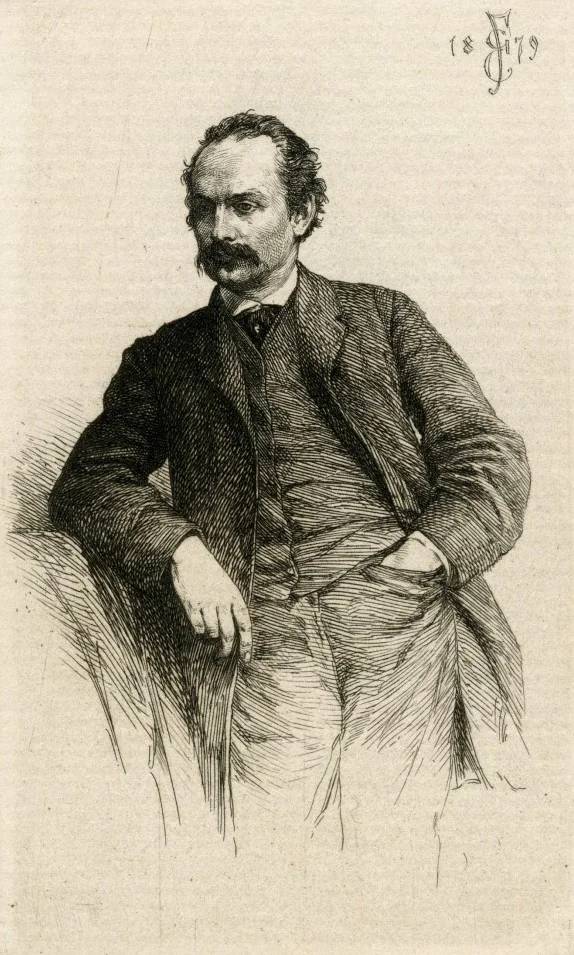
Image from Wikipedia
Image from Wikipedia
Hugo Harrer – Landscape, Architecture, and the Gaze of the Modern Realist
A German Painter Between Architectural Studies, Nature Observation, and Roman Longing
Hugo Paul Harrer (born February 6, 1836 in Eberswalde; died December 10, 1876 in Rome) is among the German landscape and architectural painters of the Düsseldorf school. His artistic career tells of a determined break from a prescribed architectural career, of self-taught education, and of a gaze that early on focused on the pictorial potential of cities, ruins, and coastal landscapes. Harrer embodies that realistic precision of the 19th century, which combines nature observation, architectural study, and atmospheric effect.
Early Years: From Planned Architect to Autonomous Painter
Harrer began an architectural education but soon turned to painting and continued to develop as a self-taught artist. His artistic formation did not occur through the regular academic training but through private study in the ateliers of friends and through careful observation of nature. This independent development shapes his profile: not a routine academy painter, but an artist who developed his visual language through practice, sharp perception, and intense study of his surroundings.
The first paintings were created in Nuremberg. There, he was particularly captivated by the city's buildings and was inspired to make early attempts at architectural painting. Even in this phase, a central motif of his later work emerges: Harrer sought not just the spectacular panorama, but the characteristic place, the corner, the ruin, the urban structure with its own history and light.
Munich, Piloty, and the Opening to Realistic Modernity
After Nuremberg, Harrer moved to Munich to draw inspiration from the paintings of Carl Theodor von Piloty. This period was important for his artistic development, as it solidified his view on a contemporary, realistic painting style. The years in Munich represent a phase of orientation, during which Harrer sharpened his understanding of image construction, the impact of the motif, and the narrative power of realistic representation.
The German Biography describes him in retrospect as "a thoroughly modern realist." This captures the essence of his working method: he wanted to depict objects exactly as he saw them and placed great importance on the manner of pictorial representation. In this way, Harrer positions himself within an artistic landscape that mediates between romantic tradition and sober observation without sliding into mere decoration.
Rome as an Artistic Turning Point
Due to a chest ailment, Harrer went to Rome in 1861 or October 1862. This change of location became the crucial turning point of his career. In Rome, he joined Ludwig Passini and painted studies from nature that attracted attention for their great truth and fidelity. The Italian capital offered him not only ancient architecture and ruinous scenes but also the light and substance that lent his motifs an independent depth.
Harrer increasingly specialized in architectural images with figures, small genre scenes, and picturesque representations of street scenes, ruins, and Italian coastal landscapes. These motifs combine observed reality with compositional order. This is where the strength of his work lies: the place remains recognizable, yet it simultaneously becomes a pictorial space of stillness, time, and mood.
Düsseldorf and the Proximity to Oswald Achenbach's School
In the years 1867/1868, Harrer was in Düsseldorf and studied at the local art academy in the landscape painting class of Oswald Achenbach. This step anchored him even more firmly in the Düsseldorf school, known for its sensitivity to landscape, interest in effects of light, and careful composition. Between the Roman impressions and the Düsseldorf training, an independent style with an international perspective emerged.
From 1868 to 1872, Harrer was a member of the Düsseldorf artist association Malkasten. This affiliation demonstrates that he did not work in isolation but was engaged in a lively artistic exchange. He then returned to Rome, where he created a substantial collection of studies and sketches as a basis for oil paintings and regularly sent works to German art exhibitions from there.
Work and Visual Language: Ruins, Streets, Coasts, and Architecture
Harrer's work thrives on precise motif selection. He frequently depicted the picturesque corners of decaying ruins, street scenes, and coastal landscapes of Italy. The works carry a quiet, observational strength and combine topographical accuracy with a subtle mood. His paintings do not appear loud or dramatic, but rather focused, clear, and determined by a calm order.
Among the preserved works are Old Hanse (1868), View of the Amalfi Coast at Dusk (1871), At the Theater of Marcellus in Rome (1876), Theater of Marcellus in Rome (1876), and A Jewish Street Vendor in a Street in Siena. This selection shows the range of his interests: Northern German history, Italian coasts, Roman monuments, and scenes of everyday life coexist in his work.
Style, Realism, and Art Historical Context
Harrer is one of those 19th-century painters who did not romanticize reality but rendered it with precise observation and technical mastery. His closeness to realism is evident in his fidelity to the motif, attention to architectural details, and disciplined composition. At the same time, his painting is shaped by the Düsseldorf school, which often presented landscapes and architecture in a narrative, atmospherically dense form.
It is particularly noteworthy that Harrer did not treat architecture as a rigid inventory but as a living bearer of images infused with light, perspective, and spatial depth. His studies from nature and the later oil paintings appear immediate, without looking sketchy. In this balance of documentation and artistic condensation lies his lasting appeal for art historical considerations.
Exhibitions, Reception, and Impact
Harrer exhibited his paintings at German art exhibitions, reinforcing his status as a specialized landscape and architectural painter. Contemporary reception particularly praised his accuracy and fidelity to truth. Biographical lexicons reflect that his works stood out for their careful observation and consistent elaboration of representation.
The source material indicates that Harrer does not belong to the loudly celebrated names of art history, but rather to the reliable representatives of quality, realistic painting. It is precisely this position that makes him interesting: he represents a concentrated, technically precise art that has emerged from academic training, self-education, and European mobility.
Later Years and Death in Rome
Harrer died on December 10, 1876, in Rome and was buried in the Protestant Cemetery in Rome. That his life ended again in the city that was so formative for his art gives his biography a cohesive dramaturgy. Rome was not only a place of residence but also a resonant space for his artistic identity.
Records in the ADB also mention Hirschberg in Silesia as a possible birthplace and December 8, 1876, as the date of death. Regardless of these discrepancies, the image of a painter remains, whose work is closely connected to nature study, architectural observation, and a realistic gaze upon the world.
Conclusion: Why Hugo Harrer Remains Fascinating Today
Hugo Harrer captivates as an artist of precise vision. His paintings link architecture, landscape, and observations of everyday life into a quiet yet intense visual language that compellingly unifies the spirit of the Düsseldorf school and modern realism. Those interested in German painting of the 19th century will discover in Harrer an independent, sensitive, and art historically significant perspective on cities, ruins, and coasts.
His emphasis on atmosphere, structure, and truthfulness continues to be worth exploring today. Hugo Harrer invites us to reconsider the subtle transitions between nature, built space, and pictorial composition – and to experience his works in their original forms with an open mind.
Official Channels of Hugo Harrer:
- Instagram: no official profile found
- Facebook: no official profile found
- YouTube: no official profile found
- Spotify: no official profile found
- TikTok: no official profile found
Sources:
- Wikipedia - Hugo Harrer
- German Biography - Harrer, Hugo
- Wikipedia - Harrer (Name page)
- RKD-Digital Book - Exhibition catalog mentioning Hugo Harrer
- Wikipedia: Image and text source