Startups & Innovation Events in Münster – Startup Hub
Startups & Innovation Events in Münster (from now on): Scene, Calendar, and Entry Opportunities
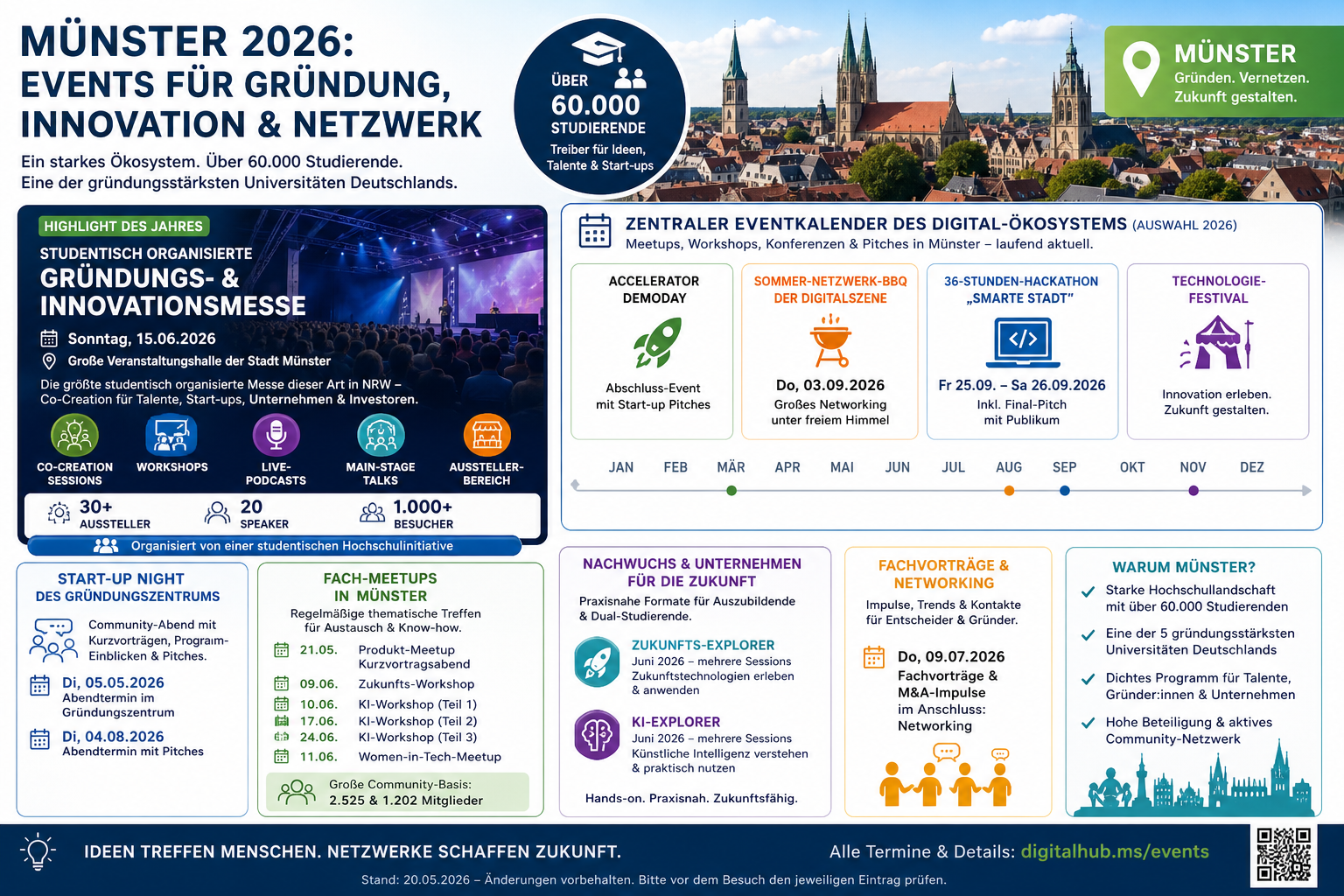
Münster has developed into a visible founding and innovation location – shaped by universities, hubs, and an active meetup culture. This overview shows which event formats typically take place in the coming weeks and months, how you can find suitable dates, and what you should pay attention to when participating.
Up-to-dateness: Focus exclusively on upcoming events and recurring formats. Specific dates may change at short notice – the official event pages are decisive.
Why Münster is interesting for startups
Münster, as a university city, is characterized by research, teaching, and a large proportion of students. This very mix ensures that new ideas emerge in short cycles: from project seminars, theses, research transfer, student initiatives, and practical partnerships with companies.
For those interested in founding, three factors are particularly relevant:
Talent & Teams: Many potential co-founders, developers, designers, and business profiles in one place.
Infrastructure: Founding and transfer offers at universities as well as regional innovation networks.
Regular formats: Meetups, workshops, pitch events, and thematic community evenings that are accessible even without prior experience.
The result: Anyone actively searching in Münster in the coming months is very likely to find a suitable event – from the first get-to-know to a professional deep-dive.
Which innovation events await you in Münster (upcoming & recurring)
1) Founding and Innovation Fairs
In Münster and the region, fairs and expo formats are also expected in the future, where startups, university projects, companies, and support organizations come together. Typical are:
Exhibitor areas (startups, initiatives, funding programs, companies)
Lecture stages with short impulses and panels
Workshops on topics such as validation, financing, prototyping, or go-to-market
If you are specifically looking for contacts (co-founders, internships, pilot customers), fairs are usually the most efficient entry point because you meet many contacts in just a few hours.
2) Pitch Nights & Demo Days
Pitch evenings and demo days are regularly announced in innovation ecosystems – often in cooperation with accelerators, universities, or networks. In the future, you can typically expect:
short startup pitches with Q&A
Jury or feedback rounds (sometimes with audience voting)
subsequent networking with founders, mentors, and company representatives
For beginners, pitch events are particularly suitable for getting a feel for typical challenges, business models, and presentation standards.
3) Hackathons & Build Weekends
Hackathons are time-compressed development formats (often over a weekend), where teams create a prototype or a first solution in a short time. Upcoming hackathons in practice often revolve around:
Smart city and civic tech topics
AI/data projects (e.g., text, vision, automation)
Sustainability, mobility, energy, or health (depending on focus)
If you want to learn quickly (tools, teamwork, pitch), hackathons are one of the most effective shortcuts.
The backbone of the scene is recurring community dates: evening meetups or multi-hour workshops. In the coming months, formats such as the following are typically expected in Münster:
Product development (discovery, roadmaps, KPIs, user research)
AI & Data (introduction, use-case design, responsible AI, MLOps basics)
Women-in-Tech & Diversity formats (networking and visibility)
Lightning talks (several short presentations in one evening)
The advantage: You can come with a low threshold, listen, ask questions, and work your way into a topic step by step.
5) Networking Evenings & Community Summer Formats
Especially in the warm season, informal networking evenings are often announced (e.g., summer networking meetings). Such dates are usually ideal if you:
want to have conversations in peace (without stage program pressure),
want to talk about cooperations,
or first want to understand who works with whom in Münster.
How to find reliable dates: Hubs, universities, communities
To really find future events (and not outdated announcements), this procedure is recommended:
Check official event calendars of regional digital and innovation networks (dates are usually consolidated most up-to-date there).
Look at university-related founding and transfer offices (startup programs, info evenings, pitch formats).
Use meetup/community platforms and social channels of the respective groups (often with waiting lists, ticket links, short-term room changes).
Important for planning: For every announcement, pay attention to date, location, registration deadline, and target group (e.g., "beginners welcome" vs. "advanced"). If an event is hybrid, also check whether networking takes place on site.
Practical tips for participation, networking, and pitch evenings
Before the event
Define your goal: Are you looking for learnings, co-founders, jobs/internships, pilot customers, or feedback?
Prepare a 30-second intro: Who are you, what are you working on, what are you specifically looking for?
Write down questions: Two to three good questions work better than "just have a look".
During the event
Listen first, then network: After talks, speakers are often easy to approach.
Give context: "I'm new to the scene" is perfectly legitimate; ask for hints about suitable groups/dates.
Secure contact properly: Save directly in your phone or via LinkedIn (with a short message where you met).
After the event
Follow up briefly within 48 hours (thanks + concrete next step).
Offer value: e.g., intro to someone, link to a tool, feedback on pitch deck.
Stay at it: Community effect arises through repetition (2–3 dates per quarter are often enough).
Added value for companies & teams: Cooperation instead of just watching
For companies in Münster (or with a location in the region), innovation events in the coming months are particularly valuable if they are used as a cooperation channel – not just as an information event. Three pragmatic approaches:
Define pilot projects: A clearly defined challenge (e.g., process, data pipeline, customer service) as a conversation starter.
Build talent contacts: Meetups and demo days are suitable for reaching professionals and interns early.
Build knowledge in the team: Workshops on product, cloud, or AI are often more efficient than pure conference visits because they lead directly into practice.
Those who participate regularly not only gain contacts, but also a better sense of which technologies and methods can realistically be transferred to their own everyday life.