Discover City Tours & Architecture Tours in Münster
City Tours & Architecture Tours in Münster: Dates, Formats, and Tips for the Upcoming Season
Anyone looking to rediscover Münster in the coming months can look forward to city tours and architecture tours that connect historical urban spaces, contemporary buildings, and urban districts into a comprehensible overall picture.
What the Upcoming Tours Are About
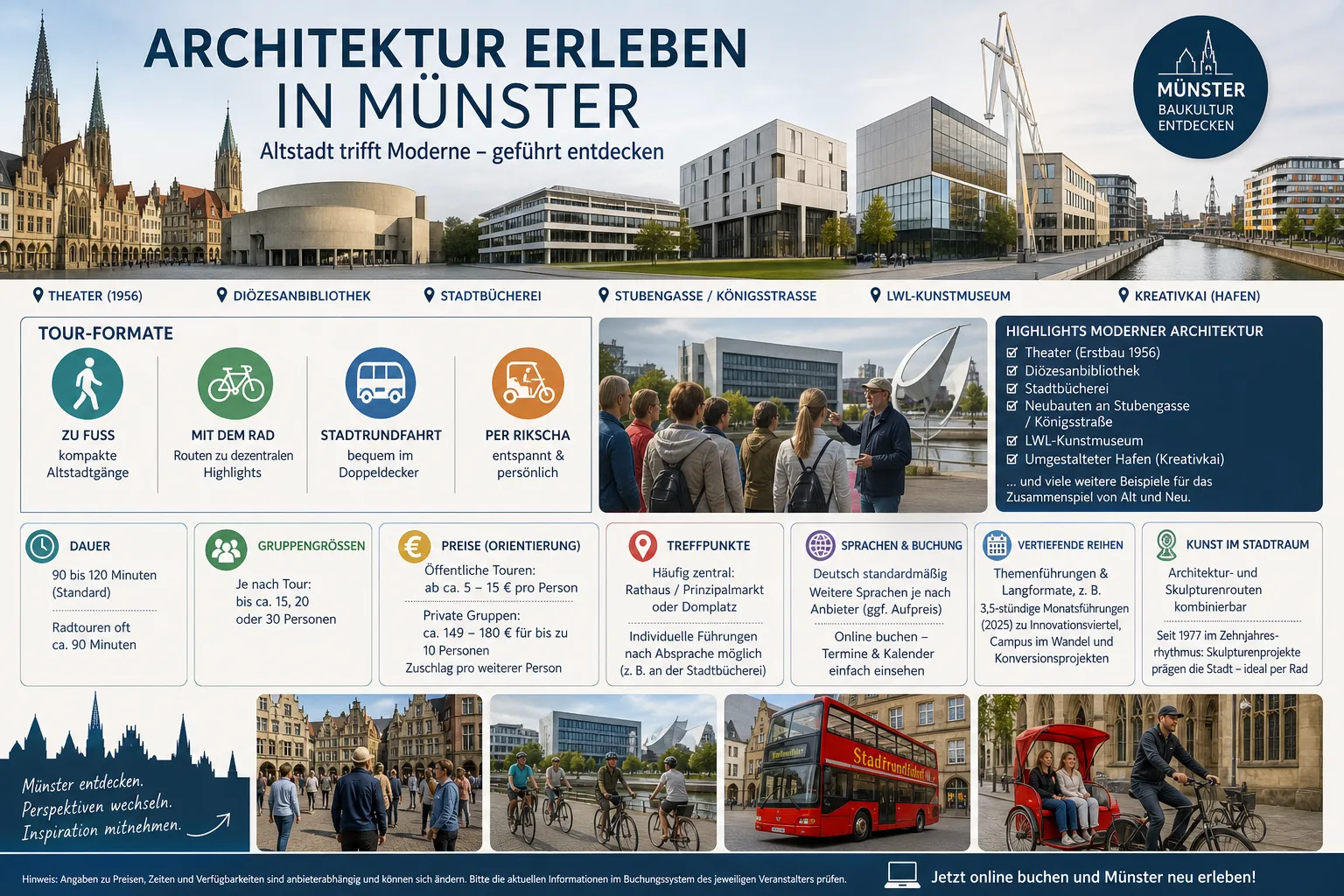
In Münster, various city tours and architecture tours will be offered in the coming season, showing well-known places from a new perspective: facades, materials, sightlines, routing, and the question of how public buildings, squares, and districts function. Many formats are designed so that you not only look at "highlights" but also understand on site why certain building types, passages, or urban spaces are designed the way they are.
Typical stops that may play a recurring role on various routes in the future include:
- Prinzipalmarkt & Cathedral Area as an introduction to scale, public spaces, and cityscape.
- Downtown districts around passages and shopping streets, where modern building blocks are integrated into the old town structure.
- City Library as an example of a public place for learning and encounters.
- Museum and cultural venues, where architecture, light, and urban space interact.
- Harbor / Kreativkai as an area where work, culture, and gastronomy are combined with new district development.
Which stops are actually included depends on the respective provider, group size, and focus (architecture, urban development, culture, art in public space).
Formats 2026/2027: On Foot, by Bike, by Bus, or by Rickshaw
1) Architecture and Old Town Tours on Foot
Walking tours will be especially suitable in the coming months if you want to experience closely located places without time pressure. Many routes focus on short distances, several stops, and room for questions. This creates more of a shared reading of the city than a pure facts lecture.
Practical: Walking tours can be easily combined with a museum visit or a café stop, as the start and end are often in the city center.
2) Architecture Tours by Bicycle
Bicycle tours are also particularly attractive for the coming season because they can cover greater distances. This makes additional districts, axes, and urban spaces accessible that are often left out on a classic walking tour.
Bicycle tours are often thematically expanded – for example, to include art in public space or questions of urban development. This can be very vivid on site: How does an object in public space influence the perception of a building? What kind of routing makes a place "functional" or "inviting"?
3) City Tours by Bus/Double-Decker and Individual Rickshaw Tours
If you want to better understand the relationships in the city layout (e.g., spatial relationships between the center, harbor, and other districts), bus or double-decker tours are a convenient option in the coming season. They are also suitable for groups with very different mobility needs.
Rickshaw tours are often booked as an individual, more relaxed alternative: close to the street, flexible in the route, and well suited for small groups who want to set a clear focus (e.g., "cultural venues," "harbor," "modern building blocks in the city center").
Planning for Upcoming Dates: Duration, Group Size, Price Logic
Typical Duration
- Walking tours: often about 90 minutes to 2 hours (depending on the number of stops and amount of discussion).
- Bicycle tours: often from about 90 minutes; longer routes are possible if additional districts or art stops are included.
- In-depth special formats: sometimes significantly longer if a topic (e.g., urban development, harbor, cultural venues) is covered in detail.
If you want to "tick off" as many places as possible, a shorter tour with fewer stops makes sense. If you really want to understand architecture, a format with more time per stop is worthwhile.
Group Sizes
For the coming season, experience shows: The smaller the group, the more dialogical the tour.
- Small groups are suitable for architectural details, follow-up questions, photo stops, and individual interests.
- Larger groups are practical for classic city center formats or tours, but rely more on lectures and clear stopping points.
Price Range (Guidance)
Prices will vary depending on the provider, duration, and format. For the coming season, these patterns are typical:
- Public tours: often in the low to mid double-digit euro range per person (depending on duration and topic).
- Private group tours: often calculated as a flat rate; the total price depends on time required, language, and route.
The current information on the respective booking portal or the organizer's website is always binding.
Booking & Preparation: How to Make the Tour Stress-Free
Languages and Content Focus
Most offers will take place in German in the coming season; additional languages are often available as an option depending on the provider. In terms of content, you can choose focal points in many formats or coordinate them in advance for private tours, for example:
- Modern architecture in the city center (public buildings, passages, urban spaces).
- Harbor / Kreativkai (district character, conversion, city by the water).
- Cultural and museum venues (architecture as a framework for art and city life).
- Art in public space as a supplement to city and architectural history.
Calendar, Tickets, Timing
For upcoming dates, many tours are organized via online calendars with fixed slots; private groups can often request separate time slots. If you are coming to Münster on weekends or during holiday periods, early booking is especially helpful.
Practical Packing List
- Comfortable shoes for longer standing times and different surfaces.
- Weatherproof clothing, as many stops take place outdoors.
- Beverage, especially for longer routes or bike tours.
- Note questions or interests (e.g., "choice of materials," "urban space," "mixed use," "accessibility") so that the tour is as relevant as possible for you.
Why Architecture Tours in Münster Are Worthwhile in the Coming Months
In the coming season, architecture tours in Münster will be especially worthwhile if you want more than a classic list of sights. Good tours make it possible to experience how a city is organized today: Where do meeting places arise? Which buildings are important for learning, culture, and everyday life? How does a district by the water change the perception of the city?
Whether as a visitor program, team outing, study impulse, or a "see anew" moment for locals: The upcoming city tours offer a structured, comprehensible approach to Münster – with concrete places, understandable observations, and room for exchange.